


Matthew Ayariga is one of only 21 people officially recognized as 21st-century martyrs by both the Coptic Orthodox Church and the Catholic Church.
But he has a further distinction: He is the only one among the 21 who was not a Coptic Orthodox Christian. He may not have been a Catholic either.
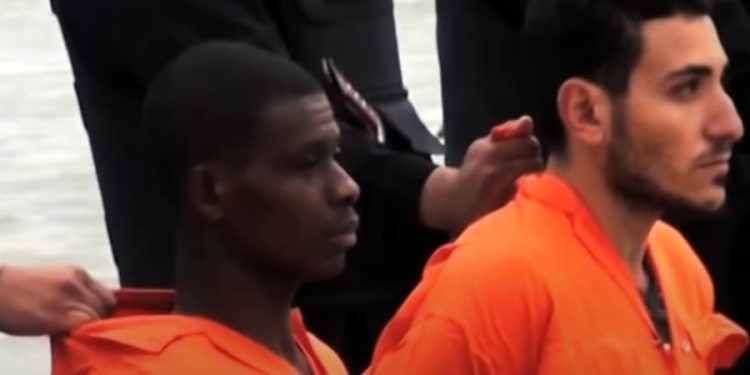
An Islamic State leader holds Matthew Ayariga, left, by the collar of his orange jumpsuit before his execution on Feb. 15, 2015.
Ayariga was beheaded along with 20 construction worker colleagues by Islamic State militants on a beach in Libya in February 2015. They were canonized together as martyrs days later by Coptic Orthodox Pope Tawadros II.
This Thursday, Pope Francis announced that, with Tawadros II’s consent, the 21 martyrs would “be included in the Roman Martyrology as a sign of the spiritual communion uniting our two Churches.”
But while Ayariga’s death as a martyr will be remembered liturgically for centuries to come by both Coptic Orthodox and Catholic believers, what do we actually know about the man’s life?
The mysteries of martyr Matthew
When was Matthew Ayariga born? What was his hometown? What religious community did he belong to? Such simple questions do not appear to have clear-cut answers.
Most sources agree that Ayariga was from Ghana, though shortly after his death there was speculation that he might be from Chad, which borders Libya.
In contrast with the other 20 martyrs, no date of birth or birthplace is listed for Ayariga. Perhaps he was born in the 1980s or early 1990s, like the majority of his colleagues. That would mean he was in his 20s or 30s when he was killed.
Many accounts suggest that he was raised as a Christian. That would not be surprising if he was from Ghana, where around 71% of the population is Christian, mainly belonging to Pentecostal churches and other Protestant communities. Some believe that Ayariga was a Catholic, which is possible, though Catholics account only for around 13% of Ghana’s population.
But nothing seems to be known of Ayariga’s early years. When he came of working age, he presumably decided to leave his homeland and earn a living as a migrant worker.
By early 2015, he had found his way to the Libyan port town of Sirte, having fallen in at some point with a group of Coptic Orthodox construction workers from various villages in Egypt.
A gruesome propaganda video released by Islamic State in February 2015 showed Ayariga and his colleagues dressed in identical orange jumpsuits as they were led along a beach by towering black-clad figures.
The 21 were lined up facing away from the waves, each with an Islamic State member behind them. As they were forced to their knees, the camera panned across them, showing Ayariga kneeling serenely in front of the leader, the only one of the terrorists not dressed in black.
The workers — many of whom were clearly praying in their final moments — were then simultaneously beheaded.
The five-minute video depicting their murder described the 21 as “people of the cross, followers of the hostile Egyptian church.”
It was said that the militants had questioned Ayariga about his faith before his death, no doubt wondering what linked him to a group of Egyptian Christians. Ayariga reportedly told them simply that “their God is my God.”
A long journey to Egypt
After the Islamic State was driven out of Sirte, local authorities said they had located the construction workers’ bodies. DNA tests confirmed that the remains were indeed those of the martyrs.
Twenty of the bodies were flown on May 15, 2018, to Egypt, where they were greeted with the nationwide ringing of church bells. They were laid to rest in a shrine dedicated to their memory.
But Ayariga’s body remained in Libya.
In 2019, a delegation requested that Ayariga “be joined with his Coptic brothers in their final resting place.” The Libyan government agreed and his remains were transferred to Egypt in September 2020. The martyrs’ families were quoted as saying: “Our joy is complete.”
Blood and baptism
In a March 2019 article published by First Things, the German author Martin Mosebach reflected on Ayariga’s spiritual journey.
Mosebach, the author of “The 21: A Journey into the Land of Coptic Martyrs,” noted that the Roman Martyrology includes the feast of the martyrs Felix and Adauctus, celebrated Aug. 30. As Felix was being taken to his execution in 303 A.D., Adauctus saw him and was moved to make his own proclamation of the Christian faith. The two men were then put to death together. Mosebach suggested that Ayariga was the Adauctus among the 21 martyrs in Libya.
The Islamic State initially believed that he wasn’t a Christian and planned to release him, Mosebach said. But Ayariga insisted that he was.
“Had Matthew survived and expressed a desire to be accepted as a Copt, he would have had to undergo baptism again,” Mosebach wrote. “Like many Orthodox churches, the Coptic Church doesn’t recognize baptisms performed by other churches.”
“So is Matthew simply an unbaptized person who somehow became a saint? Not at all. By his willingness to die alongside his Coptic companions, he received baptism on the Libyan seaside. His own blood took the place of both the holy water and the priest’s christening in the sacrament.”
Mosebach was referring to the ancient Christian teaching of “baptism by blood.” As the Catechism of the Catholic Church explains, “the Church has always held the firm conviction that those who suffer death for the sake of the faith without having received Baptism are baptized by their death for and with Christ.” It adds that “this Baptism of blood, like the desire for Baptism, brings about the fruits of Baptism without being a sacrament.”
Mosebach told The Pillar May 12 that the martyrs’ inclusion in the Roman Martyrology was “the best news from Rome for a long time.”
“At last, the core of the Christian message is once again placed in the center: the following of Christ through the acceptance of his world-redeeming Cross,” he said via email.
Mosebach, a supporter of the Traditional Latin Mass, added: “At the same time, this is also connected with a turning to the Coptic Church, which calls itself ‘the Church of the Martyrs’ and whose example is good for Western Catholic Christianity: The unrestricted commitment of the Copts to Christian tradition and the traditional liturgy reminds the Roman Church, which currently places both under ‘ideological suspicion,’ to review its own relationship to the tradition.”
“The long unjustified suspicion that the Church of Alexandria proclaims a false image of Christ in the form of ‘Monophysitism’ has probably also been silenced.”
He added: “Pope Francis is especially to be thanked for pointing out the ancient doctrine of ‘baptism by blood,’ especially with regard to the saintly Matthew, who came from Ghana and was not a Copt. Pope John Paul II created the concept of an ‘ecumenism of martyrs’ — now it has been filled with reality.”
Non-Catholic saints
With his inscription in the Roman Martyrology, Matthew Ayariga will be listed among the saints and blesseds recognized by the Catholic Church. The feast day of the 21 martyrs is expected to be Feb. 15, the day they are remembered in the Coptic Orthodox Church.
The French news agency I.Media cited an unnamed Vatican source who said that the 21 would be recognized as saints by the Catholic Church. The source said this was “only possible because these baptized persons are already recognized as saints by the Coptic Church.”
Vatican News noted that other non-Catholics have previously been added to the Roman Martyrology, including, in 2001, the 11th-century saints Theodosius and Anthony of Pečerska, and the 14th-century saints Stephen of Perm and Sergius of Radonezh.
The 21 martyrs have inspired some striking contemporary icons. It is easy to spot Ayariga in the rows of identically clad figures: The lone sub-Saharan African, depicted in an orange jumpsuit with a halo and sometimes a crown.
Set beside those of this extraordinary group of Christians, his story, too, stands out.






Discussion about this post