


Question By Augustine Alirinbey Amangwon, Sandema:
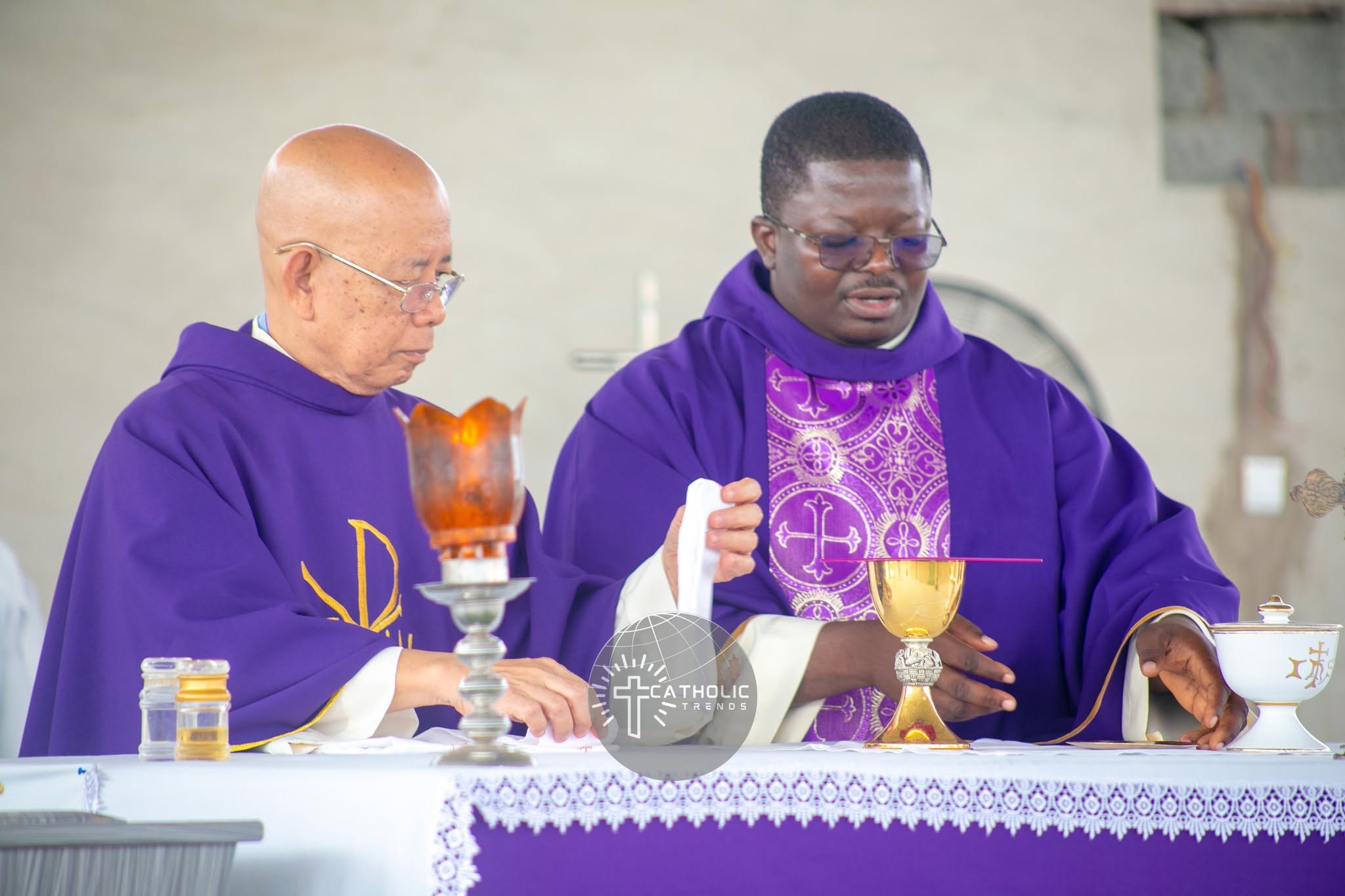
My Lord, if a parish has three outstations but only one priest to serve them, may the priest celebrate Mass at the main station and then proceed to celebrate Mass at each of the three outstations on the same Sunday or solemnity? In other words, where pastoral circumstances require it, may a priest celebrate four Masses on the same calendar day—one at the main station and three at the outstations? I would be grateful for Your Lordship’s clarification on what canon law permits in such a situation.
Answer By Most Rev. Joseph Osei-Bonsu:
This issue is addressed by Canon 905 §1 of the 1983 Code of Canon Law which states:
“Except in cases where the law permits him to celebrate or concelebrate the Eucharist several times on the same day, a priest may celebrate the Eucharist only once a day.”
The canon establishes the celebration of Mass once a day as the general rule for a priest. The phrase “except in cases where the law permits” is important because the law itself provides certain exceptions, principally in Canon 905 §2, which permits a priest, under specified circumstances, to celebrate Mass more than once on the same day.
The celebration of two Masses by the same priest on the same day is known as bination, while the celebration of three Masses by the same priest on the same day is known as trination. Canon 905 §2 permits these additional celebrations when there is a shortage of priests and a just pastoral reason, such as the need to provide for different communities that could not otherwise participate in the Eucharist. On Sundays and holy days of obligation, the diocesan bishop may permit a priest to celebrate three Masses when pastoral necessity warrants it.
Bination and trination are therefore exceptions to the general rule that a priest celebrates Mass only once a day. They are not, however, an unlimited concession based simply on the number of communities a priest serves. Canon 905 §2 establishes a clear maximum: even when the pastoral circumstances justify multiple celebrations, a priest may celebrate no more than three Masses on the same day. Consequently, the fact that a priest is responsible for several outstations does not, by itself, authorise him to celebrate a fourth Mass on the same Sunday.
The wording matters: the permission for a third Mass is tied specifically to Sundays and holy days of obligation, and depends on both a shortage of priests and pastoral necessity. The canon does not scale upward with the number of communities a priest serves. Having three outstations does not, by itself, stretch the ceiling from three Masses to four.
Applying This To The Four-Community Scenario
If a parish has one main station and three outstations all needing Mass on a given Sunday or solemnity, and only one priest is available, celebrating at the main station plus all three outstations means four Masses that day. Canon 905 §2, at most, authorises three; a fourth community requiring Mass does not create a fourth authorisation.
Validity Versus Liceity
It is important to distinguish between validity and liceity. A sacramental celebration is valid when it truly takes place and produces the sacramental effect intended by Christ, provided that the essential requirements of the sacrament are present. It is licit when it is celebrated in accordance with the laws and disciplinary norms of the Church.
Thus, a priest who celebrates more Masses than the Church permits does not, simply by exceeding the permitted number, celebrate an invalid Mass. If he is validly ordained and uses the proper matter and form, with the required intention, he can validly celebrate the Eucharist. His action, however, may be contrary to the Church’s disciplinary law. The issue, therefore, is one of liceity rather than validity.
If no other legitimate canonical provision permits the additional celebration, a fourth Mass on the same Sunday would be illicit, because it would exceed the limit established by Canon 905 §2. Nevertheless, the Mass would still be validly celebrated. In other words, the priest would have celebrated the Eucharist truly and sacramentally, but he would have done so contrary to the Church’s law governing the number of Masses a priest may celebrate in one day.
Saturday Evening Masses
Canon 1248 §1 permits the faithful to fulfil their Sunday obligation by participating in Mass on Saturday evening. However, this does not change the calendar day on which the Mass is celebrated. For the purpose of determining the number of Masses a priest celebrates in one day, Saturday evening still belongs to Saturday, not Sunday.
Therefore, a Saturday evening Vigil or anticipated Sunday Mass is counted as a Mass celebrated on Saturday. Although it fulfils the faithful’s Sunday obligation, it does not count as one of the Masses the priest celebrates on Sunday. Thus, a priest who celebrates a Saturday evening anticipated Mass and then celebrates three Masses on Sunday has celebrated one Mass on Saturday and three on Sunday, not four Masses on Sunday.
The Role Of The Local Ordinary (or the Bishop)
Canon 905 §2 does not give a priest an automatic right to celebrate a second or third Mass. Permission must come from the local Ordinary. In a diocese, the diocesan bishop is ordinarily the local Ordinary with authority to grant this permission.
The term “local Ordinary”, however, is broader than “diocesan bishop”: under canon law it can include other persons who, by virtue of their office, possess ordinary executive authority over the faithful entrusted to their care. Thus, depending on the circumstances, the competent local Ordinary may be the diocesan bishop or another person recognised by canon law as having that authority.
The local Ordinary may give permission for bination or trination where there is a genuine pastoral need, such as a shortage of priests and the need to provide Mass for several communities. Such permission may be given for a particular situation or, where appropriate, through general diocesan arrangements.
Nevertheless, the local Ordinary must act within the limits established by universal law. Canon 905 §2 permits a priest, for a just cause, to celebrate twice in one day and, where pastoral necessity requires it, up to three times on a Sunday or holy day of obligation. It does not provide for a fourth Mass.
Consequently, even where the diocesan bishop or another competent local Ordinary has authorised trination, that permission cannot be understood as authorising a fourth Mass on the same Sunday. The local Ordinary can apply and regulate the permission granted by universal law, but cannot dispense a priest from a limit that universal law itself does not allow him to dispense.
Solemnities
If a solemnity falls on a Sunday or another holy day of obligation, the special provision in Canon 905 §2 allowing a priest, when pastoral necessity requires it, to celebrate up to three Masses may apply, provided the other conditions of the canon are fulfilled.
However, if the solemnity falls on an ordinary weekday that is not a holy day of obligation, the fact that it is a solemnity does not, by itself, permit the priest to celebrate three Masses. In that case, the ordinary rule applies: a priest may celebrate a second Mass for a just cause, with the permission of the local Ordinary. The special permission for a third Mass under Canon 905 §2 is reserved to Sundays and holy days of obligation where pastoral necessity requires it.
The Underlying Pastoral Principle
Canon 904 encourages priests to celebrate the Eucharist frequently, even daily, since it lies at the heart of priestly ministry. That encouragement should not be confused with licence to multiply Masses without limit. The Church’s discipline balances the faithful’s pastoral needs against the dignity of the celebration and the priest’s own physical and spiritual well-being. Pastoral necessity justifies the exception; it does not suspend the rule altogether.
What To Do When One Priest Serves Four Communities
The answer lies in pastoral arrangement, not in exceeding the canonical limit. The priest may celebrate the maximum permitted under Canon 905 and arrange a Sunday Celebration in the Absence of a Priest—following norms set by the diocesan bishop—for the community left without Mass. Such a celebration can include a Liturgy of the Word and, where norms allow, Holy Communion. The community that goes without Mass can also be rotated so no single outstation is always the one deprived.
Other options include assistance from a neighbouring parish priest, a religious priest, a suitably available retired priest, or another priest able to help periodically. Where the shortage is persistent rather than occasional, it should be brought to the diocesan bishop’s attention so that Sunday schedules, pastoral boundaries, or priestly assignments can be reviewed.
Conclusion
The pastoral needs of several communities do not automatically authorise unlimited Masses by one priest. Canon 905 §1 sets once-a-day celebration as the norm; Canon 905 §2 allows the local Ordinary, for a shortage of priests and just cause, to permit two celebrations, and, where pastoral necessity requires it, three on Sundays and holy days of obligation. A priest serving a main station and three outstations may, with the requisite permission, celebrate up to three Masses on a Sunday—but the existence of a fourth community does not authorise a fourth Mass.
If the priest celebrates at the main station and two outstations, the remaining community should ordinarily receive Sunday pastoral care through another lawful means—rotation, or assistance from another priest—rather than a fourth Mass by the same priest. The final answer, then, is no: Canon 905 §2 does not permit four Masses on the same Sunday merely because one priest serves a parish with three outstations. The proper response to that pastoral difficulty is not to set aside the canonical limit, but to find a lawful arrangement that honours both the Eucharistic needs of the faithful and the Church’s discipline governing the celebration of Mass.
| For further explanations or enquiries, you may contact the author, Most Rev. Joseph Osei-Bonsu, Emeritus Catholic Bishop of Konongo-Mampong, on this number: 0244488904, or on WhatsApp (with the same number). |

Discussion about this post