


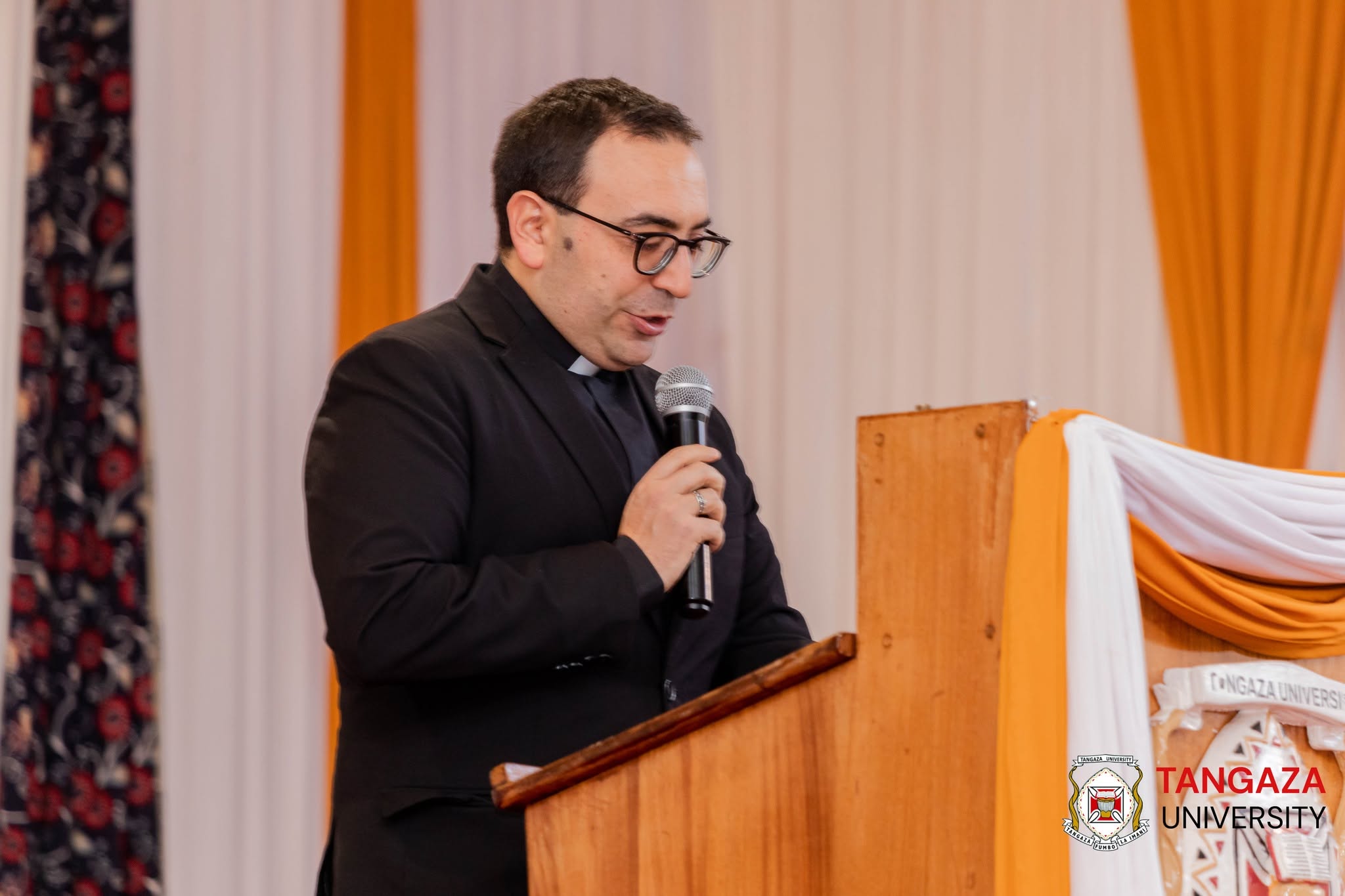
The Chargé d’Affaires at the Apostolic Nunciature in Kenya, Msgr. Luciano Labanca, has called on Catholic educators in Africa to move beyond the transmission of academic knowledge and focus on forming individuals who integrate faith and reason and apply their learning in service to humanity.
Speaking on Thursday, November 19, at the opening of the Pan African International Conference at Tangaza University (TU) in Nairobi, Kenya, Mgr. Labanca said Catholic education and theology must nurture individuals capable of combining intellectual excellence with spiritual maturity and a commitment to the common good.
He stressed that the mission of Catholic education goes beyond academic achievement, noting that it must equip students to become people whose faith informs their understanding of the world and their contribution to society.
“The purpose of theology and Catholic education is to form persons who can bring together faith and reason, intellectual rigor and spiritual depth, academic excellence and service to humanity,” he said.
Msgr. Labanca identified the ability of the Christian faith to influence and shape culture as one of the major challenges facing the Church in Africa.
“The great challenge facing the Church in Africa today is to enable our faith to generate culture,” he stated.
He added that contemporary challenges confronting the people of God require a faith that is intellectually mature, firmly grounded in truth, demonstrated through charity and capable of inspiring hope and transforming society.
Benedict XVI’s theological legacy
The Vatican diplomat said the conference provided an important opportunity to revisit the intellectual and spiritual legacy of Pope Benedict XVI, whose theological insights continue to inform the life and mission of the Catholic Church.
The three-day gathering, running from November 19 to 21, is being held under the theme, “Constellations of Hope: Africa and the Renewal of the Church in the Vision of Benedict XVI.”
It brings together Church leaders, theologians and scholars to examine how Christian hope can contribute to the renewal of the Church in Africa, with discussions focusing on Catholic education and formation, worship, Church leadership and public life.
Reflecting on Pope Benedict XVI’s understanding of the Church’s mission, Mgr. Labanca recalled a homily delivered by the late Pontiff in Aparecida, Brazil, on May 13, 2007.
In the homily, Pope Benedict XVI presented the Church as a community of disciples responding to God’s love, emphasising that the Church’s mission flows from its encounter with and experience of Christ.
“The Church does not engage in proselytism. Instead, she grows by ‘attraction,’” Pope Benedict XVI said.
Msgr. Labanca explained that this understanding challenges Catholics to recognise that the Church’s evangelising mission is best fulfilled through authentic Christian witness rather than mere persuasion.
He noted that the Church attracts people when its members embody the values they proclaim, making the Gospel visible through holiness, humility, charity and the joy of encountering Christ.
“The Church attracts when she makes visible the beauty of the gospel, when her life reflects the joy of encountering Christ, when charity becomes concrete, truth is proclaimed with humility, and holiness gives credibility to her words,” he said.
Africa’s contribution to Church renewal
Msgr. Labanca observed that Pope Benedict XVI’s theological vision has particular significance for Africa, given the continent’s rich spiritual traditions, youthful population, vibrant Christian communities and immense human potential.
He encouraged participants to use the conference as an opportunity to rediscover their Christian vocation and strengthen their commitment to building a Church whose witness inspires others.
“May these days of reflection and exchange help us to rediscover the beauty of our Christian vocation and strengthen our commitment to building a Church that attracts through the witness of holiness, serves through charity, and inspires through hope,” he said.
The conference is organised in collaboration with Tangaza University and Saint Mary’s University of Minnesota, United States, as the annual international symposium of the Vatican Joseph Ratzinger–Benedict XVI Foundation.
The gathering also forms part of Tangaza University’s 40th anniversary celebrations.
In his address, Msgr. Labanca congratulated the university on reaching the milestone and commended its contribution to Catholic higher education.
Tangaza University is jointly owned by more than 22 Institutes of Consecrated Life and Societies of Apostolic Life (ICLSAL), reflecting its collaborative commitment to theological education, research and the formation of Church leaders.

Discussion about this post