


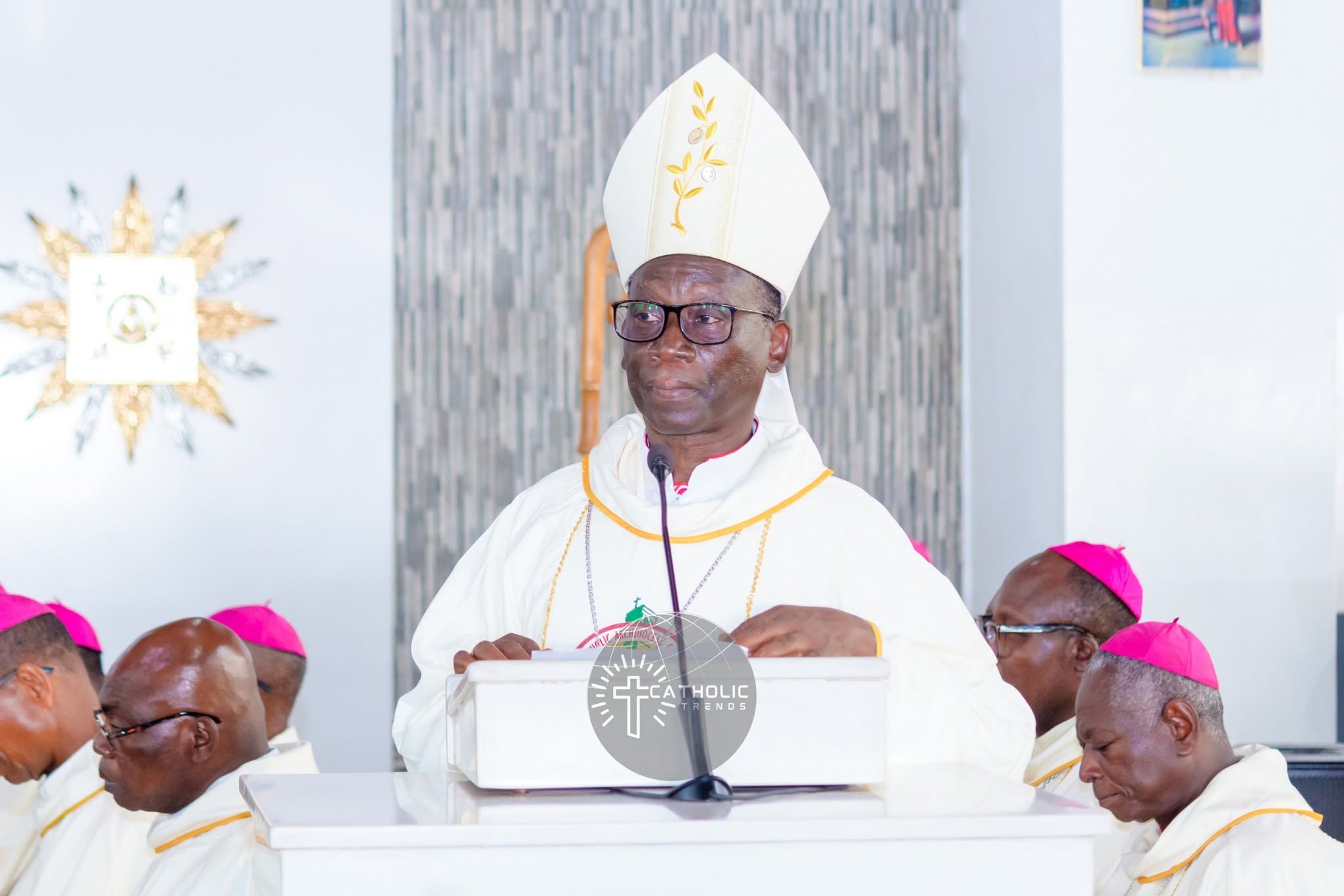
The Ghana Catholic Bishops’ Conference has clarified the Catholic Church’s practice of venerating relics following concerns sparked by a widely circulated video showing the ceremonial crowning of the skull relic of St Agatha in Catania, Sicily.
In a pastoral letter issued on Wednesday, August 26, 2026, the Bishops said the ceremony was “an act of Christian veneration, not idolatry, and certainly not necromancy or occultism”.
The ceremony, held on August 17 during celebrations marking the 900th anniversary of the return of St Agatha’s relics to Catania, saw Cardinal Pietro Parolin, Vatican Secretary of State and Pontifical Legate of Pope Leo XIV, crown the relic after Archbishop Luigi Renna of Catania had placed the saint’s skull in a restored reliquary bust.
The Bishops acknowledged that the sight of a human skull being handled and displayed had unsettled some Catholics, with the imagery evoking practices such as necromancy and occultism.
They explained, however, that the Church considers relics to be tangible reminders of the holiness of the saints. St Agatha’s skull is regarded as a first class relic because of the Church’s teaching on the sacredness of the human body and its destiny for resurrection.
According to the Bishops, the crown placed on the reliquary is a symbol of the “crown of life” promised to those who remain faithful to Christ through suffering.
“To crown St Agatha’s relic is to proclaim that a woman who remained faithful to Christ, even unto death, now shares in his victory,” they said.
The Bishops also stressed the distinction between worship owed to God alone and the honour given to the saints, explaining that acts such as kneeling before, kissing or processing with a relic are intended to honour the saint rather than worship the physical object.
They urged priests and catechists in Ghana to use the controversy as an opportunity to teach the faithful about the communion of saints and the Church’s understanding of relics.
Read the full pastoral letter below
A PASTORAL LETTER OF THE GHANA CATHOLIC BISHOPS’ CONFERENCE
On the Veneration of Relics: The Crowning of St Agatha’s Skull in Catania
To the Clergy, Religious, and Lay Faithful of the Catholic Church in Ghana
Dear People of God,
In recent days, a video has circulated widely showing the ceremonial crowning of St Agatha’s skull relic in Catania, Sicily, by Cardinal Pietro Parolin, Vatican Secretary of State and Pontifical Legate of Pope Leo XIV, after Archbishop Luigi Renna of Catania had placed the saint’s skull within the restored reliquary bust. The ceremony took place on 17 August 2026, during celebrations marking the 900th anniversary of the return of St Agatha’s relics to that city, and the Vatican has confirmed it as genuine. We write because this video has troubled many of the faithful.
For most, the discomfort was not merely at seeing a human skull handled and displayed; it brought to mind necromancy and occultism — the attempt to communicate with the dead, or to seek hidden supernatural power
through ritual, outside the worship of God. Both are condemned by Scripture (Deuteronomy 18:10–12), and it is understandable that unfamiliar imagery should evoke such associations.We wish to set out plainly what the Church intends by the veneration of relics, so that none of the faithful need remain unsettled. A relic is not a curiosity but a tangible connection to a life of holiness. St Agatha, a third century virgin and martyr honoured in the Roman Canon of the Mass, is venerated through her skull — a first-class relic — because the Church holds the human body sacred, created by God and destined for resurrection.
The Council of Trent taught that the bodies of martyrs, once temples of the Holy Spirit, are to be honoured by the faithful. This honour does not stop at the bone itself; it passes to the saint, and ultimately to God, the source of her holiness.
The crown placed upon the reliquary is not decoration, nor does it confer divine status. Scripture speaks of the crown of life given to those who remain faithful through suffering (James 1:12; Revelation 2:10). To crown St Agatha’s relic is to proclaim that a woman who remained faithful to Christ, even unto death, now shares in his victory. It is an act of veneration, not worship.
The Church distinguishes carefully between the worship owed to God alone (latria), the honour given to the saints (dulia), and the special honour given to the Blessed Virgin Mary (hyperdulia) — which, though greater than that given to any other saint, remains categorically distinct from the worship reserved for God alone.
When the faithful kneel before a relic, kiss it, or process with it, they are not worshipping the object; they are honouring the saint whose remains it holds — much as one might kiss a photograph of a departed loved one, not because the paper is the person, but because it directs affection towards the one it represents. Nothing in this act seeks to summon a spirit or extract hidden knowledge, as necromancy and occultism do.
Prayer offered to a saint is a request for intercession before God, no different in kind from asking a fellow Christian to pray for us.
Beloved in Christ, let this ceremony be an occasion for deeper understanding of our faith rather than a source of confusion. The crowning of St Agatha’s relic is an act of Christian veneration, not idolatry, and certainly not necromancy or occultism.
To anyone asking what it means to crown the skull of St Agatha, the Catholic answer is this: the ceremony honours a woman who, by tradition, remained faithful to Christ rather than renounce her faith. The crown represents a martyr’s victory and heavenly reward; the relic recalls the person who lived that life; and the honour ultimately points to God, the source of her holiness.
The crown, the kneeling, the procession, and the relic itself are not substitutes for God — they are visible signs of his grace and of the communion between the Church on earth and the saints in heaven.
We encourage our priests and catechists to use this moment to teach clearly on the communion of saints, so that the whole People of God in Ghana may grow in appreciation of this ancient and legitimate expression of Catholic piety. We invoke upon you the intercession of St Agatha, and we impart to you our episcopal blessing.
Most Rev. Matthew Kwasi Gyamfi
Bishop of Sunyani and President,
Ghana Catholic Bishops’ Conference
Wednesday, August 26, 2026
![[Sr. Angela Amoatwo, SMMC writes] Where the Church is, Mary is present: The living image of Mary and the Church](https://catholic-trends.com/wp-content/uploads/2026/08/WhatsApp-Image-2026-08-27-at-11.19.37.jpeg)





Discussion about this post