


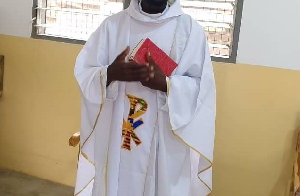
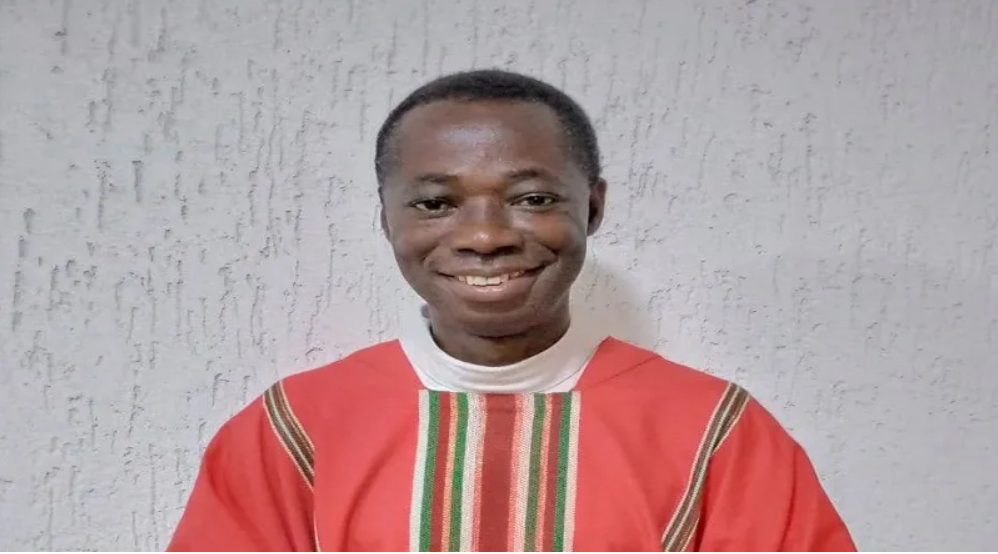
Rev. Fr. Samuel Adapore, the Konongo-Mampong priest whose suspension sparked questions over his whereabouts and welfare, has been found at the Police Training Centre in Koforidua in Ghana’s Eastern Region, the Diocese has confirmed.
According to the Catholic Diocese of Konongo-Mampong, Fr. Adapore was located at the training centre after the Diocese had been unable to establish his whereabouts following his departure from his pastoral assignment.
The Diocese said the priest had, on his own volition, enlisted as a private person into the programme at the Police Training Centre and was being trained to join the Ghana Police Service.
“The light side of it, and thanks to the prayers of many of our faithful and by the generous favour of the Lord, Fr. Samuel Adapore has been found at the Police Training Centre at Koforidua in the Eastern Region of Ghana,” the Diocese said.
The clarification was issued on Thursday, August 27, by Very Rev. Fr. John Kyere, Chancellor of the Catholic Diocese of Konongo-Mampong, following criticism on social media over the Diocese’s decision to suspend the priest while his whereabouts were reportedly unknown.
Diocese defends suspension
The Diocese said concerns raised about Fr. Adapore’s welfare were legitimate but argued that the priest’s whereabouts and his canonical status were separate issues.
It maintained that the public disciplinary statement announcing the suspension was not intended to provide a complete account of all the pastoral, administrative and canonical steps taken in the matter.
The Diocese said it had responsibilities not only towards Fr. Adapore but also towards the parish community and the wider diocesan faithful.
Fr. Adapore was until his suspension the Rector of St Anthony of Padua Rectorate, Nkwantakese.
The Bishop of Konongo-Mampong, Most Rev. John Opoku-Agyemang, had announced an indefinite suspension a divinis on August 24, prohibiting Fr. Adapore from publicly celebrating Mass, administering the sacraments and officiating at other liturgical services.
The Bishop said the action followed what he described as “serious acts” by the priest, including his unilateral decision to take a leave of absence from the Diocese and his departure from his pastoral assignment without legitimate permission.
The Diocese had also said Fr. Adapore took his personal effects from the mission house at Nkwantakese and that attempts to establish contact with him had been unsuccessful.
Diocese says welfare and discipline can coexist
In its latest clarification, the Diocese rejected the suggestion that its disciplinary action meant it had abandoned concern for the priest’s welfare.
It said the Church could simultaneously seek to establish the safety and whereabouts of a priest while addressing questions surrounding his conduct and canonical obligations.
“Concern for a priest’s welfare and concern for his canonical obligations are not competing goals,” the Diocese said.
It further argued that suspension a divinis does not mean that a priest ceases to be a priest or that the Church has rejected or abandoned him.
Rather, the Diocese said, the restriction concerns the exercise of certain priestly functions and can serve the purposes of safeguarding ecclesial order, repairing scandal and promoting reform.
Diocese addresses questions over Canon Law
The clarification also responded to questions raised about Canons 533 and 1717 of the Code of Canon Law.
The Diocese said Canon 533, which concerns a parish priest’s obligation to reside in his parish, should not be considered in isolation when assessing the canonical basis of disciplinary action.
It also said Canon 1717, which provides for an investigation when information about a possible offence is received, did not mean that ecclesiastical authority was required to remain inactive when pastoral circumstances demanded action.
The Diocese stressed, however, that the rights of the priest must be respected and that questions about whether the proper procedures were followed would require examination of the actual canonical record rather than conclusions drawn from a public statement.
It also cautioned against demanding the public disclosure of every detail concerning the priest’s circumstances, noting that Fr. Adapore’s dignity, privacy and good reputation must also be protected.
Calls for prayers
The Diocese said the discovery of Fr. Adapore’s whereabouts should not be interpreted as ending the matter but as providing an important development in a situation that had generated considerable public discussion.
It maintained that the Church’s responsibility was to combine pastoral charity with ecclesiastical responsibility.
“The proper conclusion is therefore not ‘find the priest instead of disciplining him’, but rather: find him, care for him, establish the facts, respect his canonical rights, and at the same time fulfil the Bishop’s duty to maintain the order and pastoral life of the Diocese,” the statement said.
The Diocese said it remained open to legitimate questions while also urging the faithful to avoid judging its motives solely on the basis of the earlier public statement.
READ THE FULL STATEMENT BELOW
CLARIFYING CERTAIN ISSUES ABOUT THE SUSPENSION OF FR. SAMUEL ADAPORE
Criticism has circulated on social media claiming that the Catholic Diocese of Konongo-Mampong suspended Fr. Samuel Adapore a divinis without first adequately establishing his whereabouts and welfare. Critics question whether sufficient efforts were made to locate him before imposing the suspension, suggest the Diocese is more concerned with discipline than care, and raise doubts about the canonical basis and procedure in relation to Canons 533 and 1717, including whether Fr. Adapore’s right to defence was respected.
1. The Church Is Concerned About the Priest and Must Also Protect Its Order and Mission
These concerns deserve to be taken seriously. The Diocese does not object to questions about Fr. Adapore’s welfare, whereabouts, and safety一indeed, it has every reason to share that concem. But it would be a misunderstanding to conclude from a public disciplinary statement that the Diocese cares only about punishment and not about finding, assisting, and caring for him.A statement announcing canonical discipline is not, and cannot be expected to be, a full account of every pastoral, administrative, canonical, and personal steps taken. The central flaw in the criticism is treating “Where is Fr. Samuel”as thoughit excludesWhat is the canonical status of his conduct?” These questions are not mutually exclusive.
The Church can ask whether a priest is safe while also determining whether he has abandoned his assignment without authorisation, and can seek his whereabouts while regulating his ministry. If a pastor leaves his parish, removes his belongings, stops communicating, and does not retun, the Bishop cannot simply set the matter aside indefinitely because his location is uncertain.
The Bishop has duties not only to the priest but to the parish, the faithful, and the wider diocesan community, who have a right to the sacraments and to responsible governance. The Bishop must therefore ensure ministry continues even when a priest becomes unavailable.
2. Canon 533 Cannot Be Read in Isolation
The criticism rightly notes that Canon 533 § 1 requires a pastor to reside in his parish, but does not itself prescribe automatic suspension. This does not mean other disciplinary measures are unlawful; other provisions of the Code address clerical misconduct and the exercise of ecclesiastical authority. The full canonical framework must be considered rather than isolating a single canon.
The precise basis and procedure of a particular decree depend on the facts of the case, and without the complete canonical file, an outside commentator cannot responsibly declare the Diocese acted unlawfully simply because a public statement omited the full process.
3. Canonical Discipline Is Not the Same as Abandoning Pastoral Concern
A key misconception is that canonical penalty means the Church has ceased to care. The Church does not stop being a mother because she must exercise discipline. A priest remains a human being, a Christian, a family member, and a brother to his fellow priests: genuine welfare concerns persist regardless of his canonical situation.At the same time, pastoral charity is not the same as withholding discipline. Sometimes charity requires difficult decisions. A Bishop who allows a priest to abandon his ministry without appropriate canonical and pastoral action is not necessarily showing greater charity – he may be his duty to the faithful in his care. There is no real opposition between finding the priest and disciplining him; both can and should coexist.
4. The Public Statement Was Not Meant to Be a Missing-Person Report
The criticism repeatedly asks why the statement did not detail efforts to locate Fr. Adapore. But the purpose of a canonical disciplinary statement is to communicate a decision, not to publish the full pastoral and administrative history of the case. Such a statement is not necessarily an exhaustive record of calls, visits, communications with relatives, consultations with clergy, or Canonical steps taken.
There may also be legitimate reasons to withhold personal information- a priest does not forfeit his right to privacy, dignity, and good reputation simply because he faces discipline. The absence of detail in a public statement should not be read as proof that no such efforts occurred.
5. Canon 1717 Does Not Require the Bishop to Remain Inactive
Invoking Canon 1717, which requires an investigation upon receiving information of a possible offence, is understandable. But an investigation does not mean ecclesiastical authority is barred from taking necessary administrative or disciplinary measures when circumstances demand them.
The Diocese must distinguish between establishing the facts of an alleged offence and ensuring the Church’s ministry continues to function. Ifa priest is absent and cannot be reached, the Bishop cannot leave a parish without pastoral leadership indefinitely while waiting for every detail to become clear. The Diocese must protect the faithful’s spiritual welfare while still working to establish the circumstances of the priests absence.
6. The Right of Defence Must Be Respected
Canonical justice requires fairness, and an accused priest must be afforded his rights under Canon Law. However, an inability to make contact cannot indefinitely paralyse ecclesiastical governance. The Code itself anticipates cases where an accused person fails to appear after proper summons; the Church does not operate on the principle that a person can block ecclesiastical action simply by becoming unreachable.
The real questions are whether the required procedures were followed, whether proper attempts were made to communicate with the priest, whether he was duly summoned where :necessary, and what kind of decree was actualy issued 一matters that require the actual canonical record, not conclusions drawn from a short public statement.
7. The Bishop Has Responsibilities Towards More Than One Person
The Bishop’s responsibility to Fr. Adapore is real, but not him alone. He is also responsible for the parish community, the diocesan clergy, those preparing for the sacraments, the sick and dying, families needing pastoral care, the religious and lay faithful, the Diocese as an institution, and the Church’s communion and discipline.
If a priest suddenly leaves his post, an entire community can be deprived of regular pastoral care, and the Bishop must act. It would be equally fair to ask why a Bishop would leave a parish without leadership while waiting indefinitely for a priest who has stopped communicating. Preventing that situation from becoming normal is precisely the Bishop’s duty.
8. Suspension Does Not Mean the Priest Has Been Abandoned
A suspension a divinis restricts the exercise of certain functions; it is not a declaration that the priest has ceased to be a priest, nor that the Church rejects or has abandoned him. The Church is, in effect, saying: “You are still our brother and our priest, but you cannot presently exercise certain priestly functions because of the circumstances surrounding your conduct.” This distinction matters discipline can serve a restorative purpose.
The Church’s aim is not canonical penalties exist to safeguard ecclesial order, repair scandal, and promote the offender’s refi’s reform.
9.”Punishment Before Finding Him” Is a False Dichotomy
The strongest point in the criticism is the question «”Where is Fr. Samuel?” a fair question. But claiming the Diocese is therefore more concerned with punishment than with finding him goes beyond the evidence available. Concern for a priest’s welfare and concern for his canonical obligations are not competing goals.
The Diocese can rightly say: “We want to know where our priest is, we want him safe, we want him to return to dialogue, and we must still address the canonical consequences of his unexplained departure.” These positions are not contradictory; they reflect the responsibilities of sound ecclesiastical governance.
10. Confidentiality and the Priest’s Dignity Must Also Be Protected
There is a risk in demanding that the Diocese publicly disclose everything it knows about the priest’s circumstances. If Fr. Adapore is facing personal, family, psychological, or spiritual difficulties, indiscriminate public disclosure could itself violate his dignity and privacy. The Church must balance to estahlie Sparency with confidentiality. It is reasonable to ask whether steps have been taken his welfare; it is not necessarily reasonable to demand every step be made public. The Diocese has an obligation to protect his dignity even while addressing the consequences of his actions.
11. The Diocese Is Not Fr. Samuel’s Enemy
the Bishop The tone of the criticism risks frami haloas prosecutor and Fr. Adapore as victim, which is not necessarily accurate. Both same Church, and the Bishop holds a paternal, pastoral responsibility towards his priests that a disciplinary measure does not erase. The real question is not “ls the Diocese for or against Fr. Samuel?” but “How can the Diocese protect his dignity and welfare, protect the faithful in its care, and uphold the discipline of the Church, all at once?”TIhat is the genuine pastoral and ecclesial challenge.
12. The Need for Responsible Public Commentary
Commentators should exercise caution. Without complete canonical documentation,让is dangerous to declare that the Diocese has violated Canon Law or is indifferent to its priest’s
welfare. It is legitimate to ask questions, seek clarification, appeal for compassion, and urge the Diocese to confirm the priest’s safety. But there is a real difference between asking such questions and concluding, without evidence, that the Diocese is principally interested in punishmenta conclusion not established merely by the publication of a suspension decree.13. Law and Love Must Stand Together
The Catholic Diocese of Konongo-Mampong needs not choose between law and love, discipline and pastoral charity, or accountability and concern for the priest it must practise all of them together. If Fr. Adapore’s whereabouts were genuinely unknown, every reasonable pastoral, and where necessary, civil avenue should be pursued to establish his safety.
If he were in difficulty, the Church should desire his wellbeing and reconciliation; if he wished to explain his circumstances, he should be given the canonical opportunity to do so:
At the same time, the Diocese cannot abandon its responsibility to the faithful simply because a priest has stopped communicating with ecclesiastical authority. The Bishop must safeguard the diocesan pastoral life and respond appropriately when a priest leaves his assignment without authorisation.The proper conclusion is therefore not “find the priest instead of disciplining him,” but rather: find him, care for him, establish the facts, respect his canonical rights, and at the same time fulfil the Bishop’s duty to maintain the order and pastoral life of the Diocese. That is not a failure of pastoral charity一itis pastoral charity exercised together with ecclesiastical responsibility.
The light side of it, and thanks to the prayers of many of our faithful and by the generous favour of the Lord, Fr. Samuel Adapore has been found at the Police Training Centre at Koforidua in the Eastern Region of Ghana. He has decided on his own and singular volition to be enlisted as a private person into the programme of the Training Centre and to be trained to join the Ghana Police Service.
14. Conclusion
The Diocese remains open to legitimate questions and, within the bounds of confidentiality and the priest’s rights, offer whatever clarification it responsibly can. At the same time, the faithful should resist judging the Diocese’s motives from a public statement that was never meant to disclose the entire pastoral and canonical process. Ultimately, the Diocese does not have to choose between finding its priest and governing its Church 一it does both. In the meantime, let us all continue to pray for Fr. Samuel A dapore.
Very Rev. Fr. John Kyere
Chancellor, Catholic Diocese of Konongo-Mampong Mampong-Ashanti
27 August 2026
GHANA


Discussion about this post