


Question by David Basoah:
My Lord, I want clarification regarding the Catholic and Anglican views on transubstantiation.
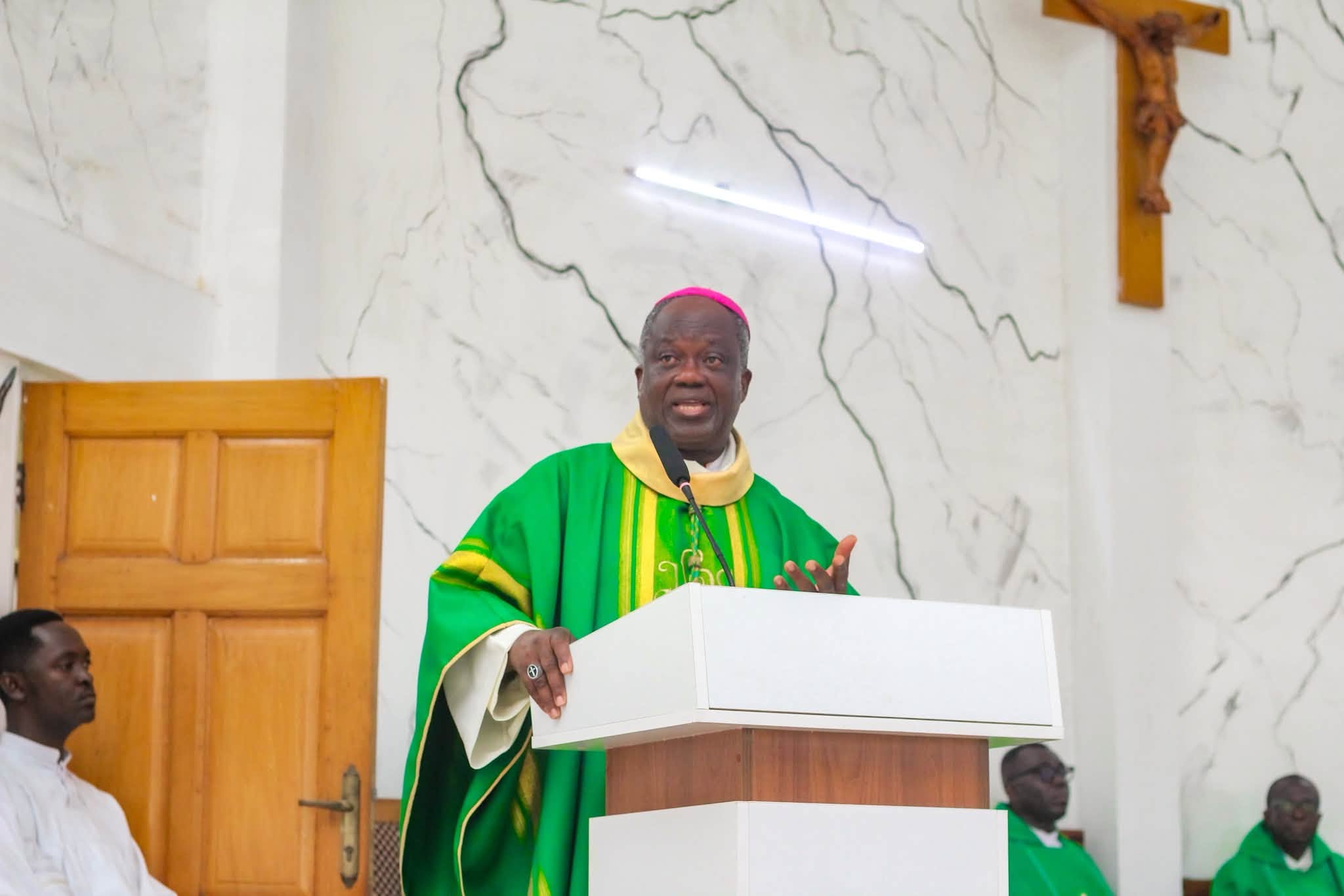
Answer by Most Rev. Joseph Osei-Bonsu:
- 1. The Foundational Belief: Real Presence
Before turning to the distinctively Catholic teaching on transubstantiation, it is important to recognise a shared foundation: belief in the Real Presence of Christ in the Eucharist. Both Catholics and Anglicans hold that when the faithful assemble to celebrate the Lord’s Supper and the words of institution are spoken, Christ is truly present and given to his people.
This presence is not merely symbolic or a simple act of remembrance, but a real participation in the living Christ. The divergence between the two traditions, therefore, does not concern whether Christ is present, but rather how that presence is to be understood and articulated.
The Catholic Church expresses this reality through the precise metaphysical framework of transubstantiation, whereas Anglicanism tends to preserve the mystery without defining the manner of Christ’s presence in such specific terms.
- 2. The Catholic Doctrine of Transubstantiation
Transubstantiation is the Catholic teaching that, at the consecration of the Eucharist, the bread and wine become the Body and Blood of Christ in substance, while the outward appearances remain the same.
This term began to appear around the twelfth century and was popularised by Peter Lombard in his Sentences. The Fourth Lateran Council (1215) employed the term in speaking of the Eucharist, and the Council of Trent (1 December 1545 to 4 December 1563) defended the doctrine against attacks by the Reformers.
This teaching makes use of Aristotelian philosophy, in which “accidents” are the changeable properties or attributes of a thing—such as colour, size, shape, taste, weight, and location—that inhere in a substance and are perceived by the senses.
Unlike substance, which is the fundamental reality that makes a thing what it is, accidents can change without destroying the thing’s identity. For example, a bronze statue may change its shape or size, but the bronze (the substance) remains. Accidents cannot exist independently but must always belong to a substance.
This philosophical distinction is central to transubstantiation, according to which the accidents of bread and wine remain unchanged even as their substance is converted into the Body and Blood of Christ. For Catholics, transubstantiation has been found to be the best way to express how Christ is present in the Eucharist, because it protects the literal truth of Christ’s words, “This is my body,” while respecting the evidence of the senses that the bread and wine continue to appear unchanged.
The Real and Complete Change
The Catholic Church holds that transubstantiation indicates a real and complete change in the inner reality of the elements, even though their taste, look, and texture do not change. This teaching was firmly defined at the Council of Trent in 1551 and remains part of Catholic doctrine today, binding upon all Catholics. The same Council was careful to point out that the Scholastic interpretation of the change in the Eucharist was not part of the doctrine. It stated simply that such explanations were appropriate to interpret the kind of change the Church was talking about (Session XIII, chapter 4, DS 877).
Unfortunately, this nuance is not always clear in popular explanations. Catholics therefore speak not merely of a symbolic remembrance but of a true sacramental change of bread and wine into Christ’s Body and Blood. Consequently, the Eucharist may be kept aside after the service, carried in procession, and worshipped, because Christ himself – his body, blood, soul, and divinity – is substantially present as long as the outward appearances continue to exist.
Scriptural and Traditional Foundations
The Catholic understanding is rooted in both the Bible and the teachings passed down through the centuries. The words of institution recorded in the Gospels and by Saint Paul – “This is my body… this is my blood” – are taken in their full and literal sense. Likewise, John 6 presents Christ declaring, “I am the living bread that came down from heaven. If anyone eats of this bread, he will live forever.
And the bread that I will give for the life of the world is my flesh.” When his hearers objected, Christ did not retreat into symbolic language but made his statement even stronger: “Unless you eat the flesh of the Son of Man and drink his blood, you have no life in you.” For Catholics, these scriptural witnesses demand a realistic interpretation, and transubstantiation provides the framework needed to honour that realism.
The Catechism’s Definitive Statement
The Catechism of the Catholic Church, in paragraph 1376, states the faith definitively: “The Council of Trent summarises the Catholic faith by declaring: ‘Because Christ our Redeemer said that it was truly his body that he was offering under the outward forms of bread, it has always been the conviction of the Church of God, and this holy Council now declares again, that by the consecration of the bread and wine there takes place a change of the whole substance of the bread into the substance of the body of Christ our Lord and of the whole substance of the wine into the substance of his blood.
This change the holy Catholic Church has fittingly and properly called transubstantiation.’” Thus, for Catholics, the Eucharist is truly, really, and substantially the Body and Blood of Christ. To deny this is, by Catholic definition, to depart from the faith of the Church.
- 4. Anglicanism and Transubstantiation
The Anglican tradition presents a more varied approach to eucharistic presence than Catholicism. The historic official position of the Church of England explicitly rejects transubstantiation. The classic Anglican formularies, especially Article XXVIII of the Thirty-Nine Articles of Religion (1571), deny transubstantiation as a required doctrine.
The Article states: “Transubstantiation (or the change of the substance of bread and wine) in the Supper of the Lord, cannot be proved by the Bible; but is contrary to the plain words of Scripture, overthroweth the nature of a Sacrament, and hath given occasion to many superstitions.” For Anglicans, the Real Presence remains foundational, but the specific explanation of transubstantiation is judged to be unnecessary.
The Three Criticisms of Article XXVIII
Article XXVIII offers three specific criticisms of transubstantiation. First, it cannot be proved from Scripture. Second, it contradicts the plain words of Scripture, which continue to speak of bread and wine even after consecration, as when Saint Paul writes, “as often as you eat this bread” (1 Cor 11:26). Third, it overthrows the nature of a sacrament, because a sacrament requires an outward sign that remains a sign. Anglicans therefore maintain the foundational belief in the Real Presence while rejecting the Catholic way of explaining it.
The Anglican Affirmation of Real Presence
Nevertheless, the Anglican rejection of transubstantiation does not necessarily imply a denial of the Real Presence. The same Article XXVIII continues: “The Body of Christ is given, taken, and eaten in the Supper, only after an heavenly and spiritual manner. The mean whereby the Body of Christ is received and eaten in the Supper is Faith.” The Anglican formularies therefore affirm that Christ is truly present and truly received, but they insist that this presence is heavenly and spiritual, not local or physical, and that the manner of this presence is a mystery.
The Cranmerian Position and the Book of Common Prayer
The bread and wine remain true bread and wine in their substance. Christ is present not by a change in the elements but through the faithful reception of the believer, who by faith shares in Christ’s Body and Blood in a heavenly manner. This position is often associated with Archbishop Thomas Cranmer, who taught a spiritual real presence: the wicked receive only the outward bread, while the faithful receive Christ spiritually. The Book of Common Prayer (1662) asks that communicants, “receiving these thy creatures of bread and wine… may be partakers of his most blessed Body and Blood.”
The Range of Anglican Belief
Within Anglicanism, there exists a spectrum of Eucharistic belief that extends beyond what is explicitly defined in its official formularies. The Anglican Communion does not require adherence to a single explanation of how Christ is present in the Eucharist.
At one end of this spectrum is the Anglo-Catholic tradition—a stream within Anglicanism that stresses continuity with the Church before the Reformation and upholds a rich sacramental theology—thereby affirming a real and objective presence of Christ closely aligned with Catholic teaching. Alongside this is the broad church, or via media, position, which likewise affirms the Real Presence but deliberately refrains from defining the precise manner of that presence.
At the other end is the Reformed or Evangelical wing, which tends to interpret the Eucharist in a more symbolic or spiritual sense. Despite these differences, all these perspectives share a fundamental commitment to the reality of Christ’s presence. Thus, whereas the Catholic Church teaches transubstantiation as the definitive and binding mode of explaining the Real Presence, Anglicanism accommodates a range of interpretations, held together more by a common liturgical life than by a single, uniform theological formulation.
- 5. The Central Difference between the two Traditions
The central difference between the two traditions is not whether Christ is present, but how that presence is explained. For Catholics, the Real Presence is foundational, and transubstantiation has been found to be the best way to express how Christ is present. For Anglicans, the Real Presence is also foundational, but the specific explanation of transubstantiation is rejected as unnecessary. Catholic doctrine requires transubstantiation as the specific explanation: the substance changes while appearances do not. Anglicanism rejects the term and the philosophical explanation but holds a range of views on the Real Presence itself.
Practical Consequences of the Difference
For Catholics, the consecrated bread is Christ and may be worshipped as such; for most Anglicans, the consecrated bread remains bread, even while Christ is truly present to the communicant in the act of receiving. Catholics keep the sacrament in tabernacles for worship and for the sick; Anglicans may keep it for the sick, but Article XXVIII forbids “the carrying about, lifting up, or worshipping” of the reserved sacrament. Catholics understand the Mass as a true sacrifice; the Thirty-Nine Articles (Article XXXI) deny that the Eucharist is such a sacrifice, calling it a “blasphemous fable.”
Polemics, Ecumenism, and Recent Theological Developments
Since the Council of Trent, the doctrine of transubstantiation has been the object of bitter polemic between Catholics and other Christians. More recently, thanks to the ecumenical movement, a more irenic spirit has prevailed.
The Scholastic interpretation is now seen as one interpretation of the Church’s teaching. After the Second Vatican Council, theological efforts to express Church teaching in contemporary language have been attempted, using terms such as transfinalization and transignification. In response, the Holy See has emphasised the real (or ontological) change which occurs in the Eucharist through the words of consecration.
Ecumenical Dialogue and ARCIC
The Anglican-Roman Catholic International Commission (ARCIC) has worked for decades to find common ground. The ARCIC document on Eucharistic Doctrine (1971) declared that the two traditions share a common faith in the Real Presence, even while acknowledging that the historical language of transubstantiation remains a point of difference. Nevertheless, official Catholic teaching (Catechism of the Catholic Church, paragraph 1400) states that “ecclesial communities derived from the Reformation… have not preserved the genuine and total reality of the Eucharistic mystery,” and therefore the Catholic Church does not recognise Anglican Eucharists as valid.
- 6. Summary
To summarise: the Real Presence of Christ in the Eucharist is the foundational belief for both traditions. For Catholics, transubstantiation has been found to be the best way to express how Christ is present – a precise philosophical explanation that the substance changes while appearances do not.
The term emerged around the twelfth century, was popularised by Peter Lombard, and was later defended by the Council of Trent, which distinguished the doctrine from particular Scholastic interpretations. Anglicanism rejects the term and the philosophical explanation but holds a range of views on the Real Presence itself – from a strong objective presence to a purely memorial understanding.
The two authoritative texts are, on the Catholic side, the Catechism of the Catholic Church, paragraph 1376, and on the Anglican side, Article XXVIII of the Thirty-Nine Articles. Both traditions affirm that Christ is truly given to the faithful in the Eucharist. They differ fundamentally on what the consecrated elements are in their deepest reality and on whether that reality can or should be defined in metaphysical terms.






Discussion about this post