


Tuesday, September 28, 2021
THE CLERK TO THE COMMITTEE
COMMITTEE ON CONSTITUTIONAL,
LEGAL AND PARLIAMENTARY AFFAIRS
OFFICE OF PARLIAMENT
OSU-ACCRA
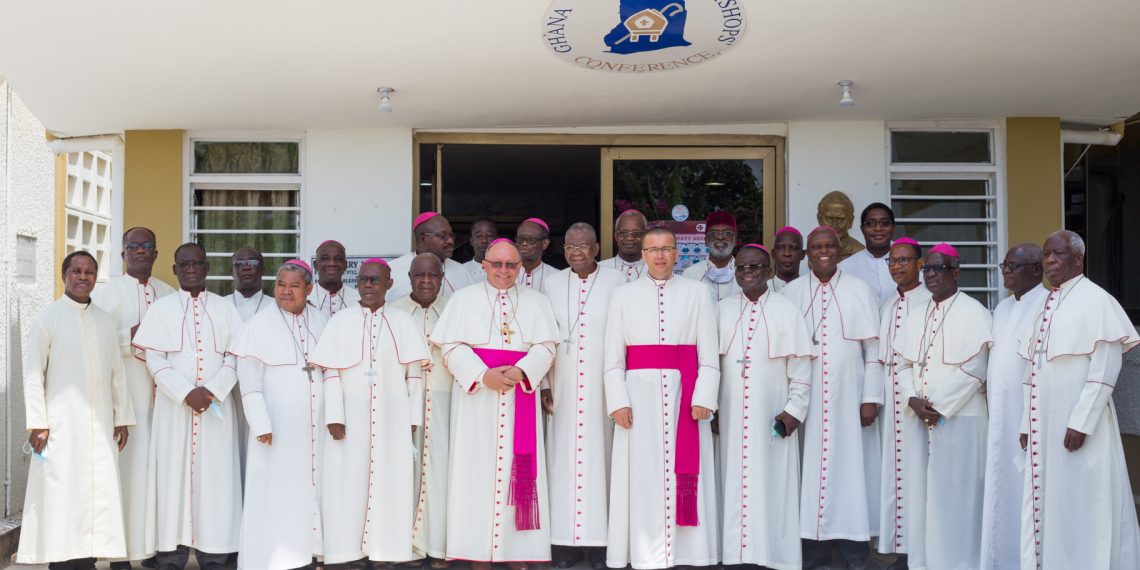
GHANA CATHOLIC BISHOPS’ CONFERENCE’ PAPER ON THE DRAFT BILL ON
HOMOSEXUALITY IN GHANA
We, the Catholic Bishops of Ghana, write in support of the draft Bill presented to Parliament to make homosexual practices illegal in Ghana. Our voice needs to be heard on this matter not only because, in our view, it is morally unacceptable but also because according to the 2010 population census, the Catholic Church in Ghana constitutes a sizable percentage of the population, i.e., about 13.1 percent of the population of Ghana. As a Church, we want this abominable practice made illegal in our country. Our reasons will become clear from the following.
The Bible and Homosexuality
The Bible, which is foundational to Christian beliefs and practices, condemns the practice. In the Old Testament, this practice was seen as a perversion and a pagan abomination. In Lev 18:22 we read, “You shall not lie with a male as with a woman; it is an abomination”. Similarly, in Lev 20:13 we read, “If a man lies with a male as with a woman, both of them have committed an abomination; they shall be put to death, their blood is upon them”.
Another passage relevant in this discussion is Gen 19:1-28. While admittedly the text of Gen 19:1-28 does not deal with homosexual people, it does not deny the fact that what the men of Sodom intended to do with the two male guests of Lot constituted homosexual acts (cf. Gen 19:5: the Hebrew verb “yada’” is a biblical euphemism for sexual relations). Lot’s offer to give his two virgin daughters in place of the two male guests shows that he perceived the desire of the men of Sodom as perverted lust.
While the idea of intolerance and hostility towards the stranger is present in the text, it is certainly sexual perversion, i.e., their desire to engage in homosexual acts, which is at the root of the crimes of the men of Sodom.
Most of the references to homosexuality in the New Testament occur in the letters of Paul. The clearest is Rom 1:26-27. In this passage, Paul argues that pagans, even without the biblical revelation, ought to have honoured the true God but they turned instead to idolatry. Because of this primary disorder, God gave them over to sexual disorder as well, both women and men exchanging natural relations for unnatural ones: “For this reason God gave them up to dishonourable passions.
Their women exchanged natural relations for unnatural, and the men likewise gave up natural relations with women and were consumed with passion for one another, men committing shameless acts with men and receiving in their own persons the due penalty for their error” (Rom 1:26). This passage (Rom 1:26) is the only biblical text that addresses the particular issue of homosexual behaviour between consenting females.
Rom 1:27 is the clearest statement in the New Testament regarding the issue of homosexual behavior between consenting adult males. Some interpreters suggest that Paul has in mind here sexual relations between men and boys (pederasty); however, Paul’s indictment seems to include all kinds of homosexual practice, female as well as male, and was not directed against one kind of homosexual practice in distinction from another. In 1 Cor 6:9-10; 1 Tim 1:10 Paul speaks of homosexuality. These two verses may be discussed together.
In 1 Cor 6:9-10 Paul says, “Do you not know that the unrighteous will not inherit the kingdom of God? Do not be deceived; neither the immoral, nor idolaters, nor adulterers, nor sexual perverts nor thieves, nor the greedy, nor drunkards, nor revilers, nor robbers will inherit the kingdom of God”. In 1 Tim. 1:10 Paul speaks of “immoral persons, sodomites, kidnapers, liars, perjurers, and whatever else is contrary to sound doctrine”.
The terms “sexual perverts” and “sodomites” in the two passages translate the same Greek word (arsenokoitai) and refer to homosexuals. The Greek word is a compound of “male” and “intercourse”. While its meaning is not easy to determine because of its seldom use in extant literature of the period, it is generally understood as referring to male homosexual offender. In fact, the highly rated Greek – English Lexicon of the New Testament and Other Early Christian Literature translates arsenokoites (singular) as “a male who practices homosexuality, pederast, sodomite”.
The claim by some homosexuals that it refers to exploitative sexual relationships between men, and not to durable ones based on love and mutual care is neither supported by the immediate context of I Corinthians 6:7-11 nor by what we know of the Graeco-Roman society of the time. Paul is here warning his Corinthians Christians against engaging in homosexual acts which he considers as sinful and undignified of the Christian.
The Catholic Church’s Teaching on Homosexuality
The Catholic Church has addressed the issue of homosexuality in a number of documents. The Church’s teaching on homosexuality can be summarized as follows:
- The Church sees the practice of homosexuality as something condemned by the Scriptures and cites in its documents the biblical passages mentioned above that condemn homosexuality. In addition to these passages, the Church sees the practice of homosexuality as being incompatible with the creation stories relating man and woman in Genesis. In the opening chapters of Genesis, the creation of the sexes by God is presented as having a twofold purpose: men and women are meant to come together in a one-flesh unity of life (Gen 2:24) and to beget children (Gen 1:28). Since sexual activity was seen to be ordered to procreation and the continuance of the human race, any form of sexual activity other than heterosexual intercourse is against nature and is a clear violation of right reason.
To choose someone of the same sex for one’s sexual activity or for marriage is to annul the rich symbolism and meaning, not to mention the goals, of God’s sexual design. Homosexual activity is not a complementary union, able to transmit life, and so it thwarts the call to a life of that form of self-giving which the Gospel says is the essence of Christian living. - The Church makes a distinction between “the homosexual condition or tendency” and “individual homosexual actions”. For the Church, the latter is “intrinsically disordered” and is “in no case to be approved of”. In other words, while the Church does not condemn people for being homosexuals or for having the homosexual tendency, it condemns the homosexual acts that homosexuals perform.
- Although the particular inclination of the homosexual person is not a sin, it is a more or less strong tendency ordered towards an intrinsic moral evil, and thus the inclination itself must be seen as an objective disorder.
- The Church rejects the unfounded and demeaning assumption that the sexual behaviour of homosexual persons is always and very compulsive and, therefore, they should not be blamed for their homosexual acts.
- Even though the Church strongly condemns homosexual acts, it insists that the rights of homosexuals as persons should be respected. Homosexuals are also human beings, created in the image of God, and they should enjoy the same fundamental human rights that all people enjoy. However, what are these human rights? By human rights, we mean the universal, inviolable and inalienable rights that are due to the human person as a rational being possessing a free will. Human rights protect, or are intended to protect, the dignity of the human person against State and Society. Specific human rights include the right to life, personal liberty and due process of law; to freedom of thought, expression, religion, organization, and movement; to freedom from discrimination on the basis of race, religion, age, language, and sex; to basic education; to employment; and to property.
Nevertheless, according to the Church’s understanding of human rights, the rights of homosexuals as persons do not include the right of a man to marry a man or of a woman to marry a woman. For the Church, this is morally wrong and goes against God’s purpose for marriage. We should also point out that the European Court for Human Rights has ruled that same-sex “marriages” are not considered a human right, making it clear that homosexual partnerships do not in fact equal marriages between a man and a woman. The ruling was announced 9 June 2016 in the European Court of Human Rights in Strasbourg, France.
Nonetheless, in the view of the Church, it is not right to subject homosexuals to any form of harassment simply because they are homosexuals. The intrinsic dignity of each person must always be respected in word, in action and in law. Homosexuals must be accepted with respect, compassion and sensitivity. According to Pope Francis, the homosexual person needs to be “respected in his or her dignity and treated with consideration, and ‘every sign of unjust discrimination’ is to be carefully avoided, particularly any form of aggression or violence” (Amoris Laetitia 250). Families with LGBT members need “respectful pastoral guidance” from the church and its pastors so that gays and lesbians can fully carry out God’s will in their lives (Amoris Laetitia 250).
The long-held teaching of the Roman Catholic Church has been that while homosexual people, i.e., those who have an erotic inclination towards others of the same sex are to be loved and respected and not discriminated against, homosexual acts are intrinsically immoral. It is for this reason that the Church does not approve of “unions between people of the same sex”. Following the example of Jesus himself who came not to call the righteous but sinners to repentance (cf. Luke 5:32 [NRSV]), the Church in its pastoral care is solicitous about the salvation of all God’s children and endeavours to show them God’s love and mercy.











Discussion about this post