


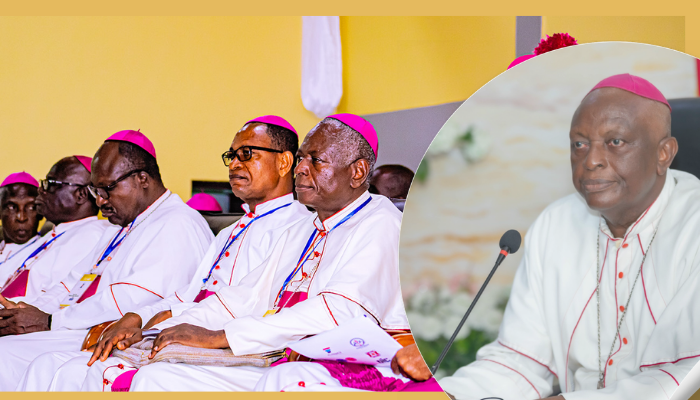
The Catholic Bishops of Ghana have appealed for calm, reflection and renewed moral clarity following public concern over curriculum materials used in senior high schools, describing the moment as one that calls for healing, vigilance and constructive national engagement.
In a statement issued by the Conference, the bishops said they were speaking “out of deep pastoral concern for the moral, cultural, and spiritual formation of our children and young people,” emphasising that “the family remains the foundational unit of society and the first school of virtue, faith, and conscience.”
They stressed that education must go beyond academic instruction, insisting that it “must therefore serve the full and harmonious development of the human person: intellectual, moral, emotional, social, and spiritual,” while also respecting “parental authority,” honouring “Ghanaian cultural identity,” and upholding “the shared values that bind our nation together.”
The bishops addressed the controversy sparked by the circulation of a Year 2 Senior High School Physical Education and Health Teacher’s Manual, which contained material widely criticised by the public. They noted that the development “caused understandable anxiety among parents, educators, and citizens who perceived a threat to traditional conceptions of family, personhood, and moral formation.”
Acknowledging steps taken by education authorities, the bishops said: “We acknowledge and welcome the clarification by the National Council for Curriculum and Assessment (NaCCA) that the officially approved national curriculum does not include LGBTQ-related lessons.” They added: “We commend NaCCA for withdrawing the offending material and issuing a revised manual aligned with national norms and values.”
However, the bishops cautioned that the issue points to broader concerns within the education system. “Nevertheless, we remain convinced that this incident reveals deeper weaknesses in oversight, consultation, and value alignment within curriculum development processes,” they said, warning that “public trust in education depends on transparency, accountability, and fidelity to constitutional and moral principles.”
They also recognised the role of public voices who called for accountability, stating: “We further acknowledge the public advocacy of Prof. Godfred A. Bokpin and Mr. Moses FohAmoaning, whose calls for a formal apology and an independent review reflect the conscience of many Ghanaians.”
As part of their response, the bishops outlined their readiness to engage constructively with the state, declaring: “We wish to state clearly that our position paper on the matter is ready to be formally submitted to the Government of Ghana, the National Council for Curriculum and Assessment, the Ministry of Education, and the Ghana Education Service.” They explained that their intention is “constructive engagement, institutional reform, and the strengthening of trust between families, schools, and the state.”
Central to the bishops’ message is a reaffirmation of core principles guiding education. They underlined that “parents are the primary educators of their children,” that “education must respect the developmental stages of children,” and that “educational content must reflect Ghana’s cultural and religious values, upholding human dignity, family life, and moral responsibility.”
Placing the debate within a broader moral and cultural vision, the bishops said: “We view education as a sacred trust,” warning that when learning materials are detached from Ghana’s moral heritage, “the result is not enlightenment but disorientation.”
At the same time, they called for balance, noting that “education must promote critical thinking, compassion, and respect for human dignity,” and affirming that “our children can be taught to reject prejudice and violence without adopting frameworks that contradict their faith or cultural worldview.”
Looking ahead, the bishops called “for a comprehensive review of curriculum development and editorial processes,” an audit into how unauthorised material entered teacher manuals, and stronger safeguards for the future. They also urged “the institutionalisation of regular stakeholder dialogue” and proposed “the establishment of ethical oversight committees” to vet sensitive educational content.
In their conclusion, the bishops reaffirmed their commitment to Ghana’s future, stating: “We, the Catholic Bishops of Ghana, reaffirm our unwavering commitment to the moral and intellectual integrity of our nation’s education system.” They reminded the nation that “education is not merely about producing skilled workers; it is about forming upright citizens, guided by conscience, rooted in truth, and committed to the common good.”
They ended with a collective appeal: “We call upon parents, teachers, policymakers, and religious leaders to stand with us in safeguarding the soul of Ghanaian education,” urging that schools remain places “where knowledge and virtue walk hand in hand.”





Discussion about this post