


Beloved Child of God and Fellow Catholics, how many times have we all not associated ourselves with famous and accomplished legends, even when we have no direct lineage or family ties with the person! The question is, why do we do that? The response may vary, but basically, it is to feel good and crave some prestige, a good name and reputation for ourselves!
I remember as a young Ghanaian seminarian in Rome, a lot of whites, knowing very well that one of their famous players, Mario Barwua Ballotelli , who has Ghanaian descent, would ask, “You said you are a Ghanaian. Do you know Ballotelli?”
Most often, we, the Ghanaian seminarians, needed to respond, “Yes,” even when we had not heard his name before.
Because it was so embarrassing and unacceptable to respond negatively.
If this is the case, how much more Mother Mary?
The Modern Doctrinal Challenge of Most Catholics
For me, most Catholics find it so hard to understand, appreciate and welcome the Marian aspect of Catholicism, and it becomes embarrassing and irritating when brethren from the Pentecostal Churches, out of ignorance, accuse us Catholics of worshipping Mary.
The Catholic hymn answers it well: “We are honouring Mary, we are honouring.
People say we worship her, not at all…”
Why Is Mary So Dear to the Catholic Church?
(A) Removing Mary from Christian devotion is like trying to raise seedlings without water! Interestingly, apart from the Apostles, she is the foundation of the Christian faith.
And just as one cannot talk about the history of Christianity without mentioning the names of Saints Peter and Paul, so can one not talk about the historical Jesus without mentioning the name “Mary.”
(B) Simply because she is the perfect model of all Christians.
And the Litany of Mary says it all when it addresses her as Help of Christians, Queen of Saints, Queen of Apostles, Queen of Virgins, Comforter of the Afflicted.
It means that if you are a child and want to remain chaste, make Mary your reference point, for she first did it: a virgin who remained a virgin even after she conceived of Jesus. In fact, she was preserved right from her birth for it.
(C) Mother Mary is the first disciple of Jesus, who, through her giving of her full will (fiat), allowed God’s project of salvation to restore the broken friendship to become a reality.
St. Augustine calls it a “happy fault.”
As a perfect collaborator, she put aside her human project so that God’s will might be done when she said:
“Behold the handmaid of the Lord, let it be done unto me according to your word” (Luke 1:38).
(D) She did not only give out her fiat but received and nursed the Word that became flesh in her womb.
If Mary was found worthy, though by grace, to be the bearer of His Son, who are we to dishonour her?
Mary’s womb became the living tabernacle of Christ. If you like, the Ark of the Covenant. And as you and I may know, the Ark of the Covenant contained God’s Word, and that Word became flesh and dwelt among us in the person of Christ.
Why We Need to Take Mary Home with So Much Joy as Catholics
- Mother Mary Is the First Disciple of Christ
It is because Mother Mary is the first disciple of Christ, a perfect model of every Christian who seeks to listen to Jesus, believe in Him and bear witness.
She was faithful right from the angelic visitation when she gave her fiat—her will—to God’s will, bearing all the seven wounds and pains she needed to endure to the point of Christ’s Crucifixion, and was even taken up to heaven, body and soul.
She shows us how to cooperate with divine grace in order to carry out God’s plan of salvation when she said: “Behold the handmaid of the Lord, let it be done unto me according to your word” (Luke 1:38).
Mary’s response at the Annunciation reveals her complete openness to God’s will. Her fiat was not merely a spoken response; it became the pattern of her entire life. She continued in faithful discipleship, even through the suffering and sorrow that culminated beneath the Cross. In this way, Mary stands before the Church as a model of faith, obedience and perseverance.
The Second Vatican Council teaches that Mary cooperated in the work of the Saviour through her obedience, faith, hope and burning charity, and that she is therefore our mother in the order of grace. Her discipleship therefore did not end with the Annunciation.
From the beginning of Christ’s earthly life, through His ministry, Passion and death, Mary remained united with her Son in faith and love. Her life teaches every Christian how to listen to Christ, trust in God’s word and remain faithful even when the path becomes difficult.
- Mary as the Living Tabernacle and Ark of the Covenant
Interestingly, Mary not only gave her will (fiat), but nursed, cared for and carried the Saviour in her womb.
So, being the bearer of God, she becomes the living Tabernacle and the Ark of the Covenant, which housed the Word that became flesh and dwelt among us.
Mary carries Jesus to give Him to humanity.
She received the Word of God not only in her heart through faith but also in her body when she conceived and gave birth to Jesus. The Second Vatican Council teaches that Mary “received the Word of God in her heart and in her body and gave Life to the world.”
This is why the Church has found rich biblical meaning in describing Mary as the Temple or Tabernacle of the Lord and the Ark of the Covenant. Pope St. Paul VI, in Marialis Cultus, notes that the Fathers and other Christian writers used these titles in reflecting upon the mystery of the Incarnation and the Holy Spirit’s action in Mary.
Thus, the image of Mary as the Ark of the Covenant points us directly to Christ: just as the ancient Ark was associated with the presence of God among His people, Mary became the living dwelling place of the Word made flesh. Her greatness, therefore, always points beyond herself to Jesus, whom she received, carried and gave to the world.
So, Mary carries Jesus to give Him to humanity.
- Jesus Gave His Mother to the Beloved Disciple
The Crucified Son, handing her over not to just any disciple but to John, the disciple He loved most, speaks volumes.
It means that Mary was more than a golden treasure to the Son. So, by extension, as disciples who love Christ, His Mother is His gift to us as a Church.
No wonder she played a massive role in the early Church.
At the foot of the Cross, Jesus said to His Mother, “Woman, behold, your son!” and then to the beloved disciple, “Behold, your mother!” (John 19:26–27). The Church understands these words not merely as an arrangement for Mary’s care after Jesus’ death, but also as expressing Mary’s spiritual motherhood of Christ’s disciples. Pope St. John Paul II explains that, at the Cross, Christ gives His Mother to the disciple and, through him, to every disciple of Christ.
Therefore, when Catholics take Mary home as their Mother, they are responding to a gift that comes from Christ Himself. The beloved disciple represents the disciple of Christ who receives Mary in faith and welcomes her into his life.
The Second Vatican Council likewise teaches that Mary, by her maternal charity, cares for the brethren of her Son who are still journeying on earth, and that the Church invokes her as Advocate, Auxiliatrix, Adjutrix and Mediatrix, while making clear that her maternal role neither takes away from nor adds anything to the unique mediation of Christ.
Thus, Mary’s role always leads us to Christ. She does not replace Jesus; rather, as His Mother and our Mother in the order of grace, she helps us to remain united with Him.
- Mary’s Intercession at Cana
If Mother Mary could intervene for her Son to change water into wine at the Wedding at Cana, even when His time was not up, it tells us beyond doubt that the door to the heart of Jesus is Mary.
No wonder she is called the Gate of Heaven.
She does not mediate as Mediatrix; she pleads our cause when it is just impossible.
Her word, “Do whatever He tells you” (John 2:5), shows her deepest trust in her Son.
- Mary Is Our Mother
As Catholics, if Jesus is our brother and Mary is His mother, then logically Jesus is not only our brother by adoption through Baptism; Mother Mary is also our Mother, so we enjoy maternal guidance, spiritual motherhood, and graces from her in our pilgrimage here on earth.
- The Assumption of Mary into Heaven
The Church’s Tradition, with evidence from Revelation 12, makes us fully convinced that, after Mary’s earthly life, she was assumed (assumere in Latin: “to be taken up”) into heaven, body and soul, and crowned Queen of Heaven and Earth, who has crushed the head of the serpent.
The Akans say, “Ayɛbida wɔhɔ a, yɛnkɔfa dabidabi ɛbɛyɛ yie”: If an experienced person who has excelled is around, we do not try a neophyte.
It means that if Mary has already won the crown of glory, we are certain that, following her path, we shall definitely succeed.
So, her being taken up into heaven, body and soul, after her earthly journey gives us hope that there is life after this, and that if we live virtuously, after our earthly journey, we shall also unite with Christ in glory and be one with Him in His Kingdom.
The Akans say, “Odwan, baabi a oni ogyina no, na ne ba nso gyina hɔ”: Where our Mother is, there shall we also be as her children.
Let one not forget that if people like Enoch and Elijah were taken up into heaven and never saw death, how much more the Mother Most Pure, the Queen of Prophets?
In fact, Mary’s Assumption is the Son’s honour to the Mother, making the Church teach that, after Mary’s death, her body never saw decomposition.
It is true because how can the bearer of Christ be made to rot when Christ’s entry into her womb by the power of the Spirit has made her holy and set her apart?! St. Maximilian Kolbe beautifully expresses this Marian confidence: “I see Mary everywhere. I see difficulties nowhere.”
- The Holy Rosary and Marian Devotion
As Catholics, if through the powerful intercession of the Holy Rosary, given by Our Lady as a spiritual weapon, we were able to overcome and conquer the invading Muslims at the Battle of Lepanto in 1571, through St. Dominic and Don Diego de Azambuja, in our modern times, where the faith faces several crises, with the Rosary in our hands and through Rosary Nights and Marian devotion, we can overcome them all and obtain peace in war-torn countries.
Conclusion
My dearly beloved in Christ, I have no doubt that many of our Catholics who have a great devotion to Our Mother have countless testimonies, but please permit me to conclude by sharing one with you.
There was this accomplished Catholic who had risen through the ranks in his profession but felt insecure and so consulted a fetish priest.
The traditional priest asked him to go and come back in a week so that he could call and weigh his spirit in order to know how to fortify him spiritually on his return.
The man said that, on his return to the shrine, the priest said to him, “Sir, I tried calling your spirit several times but to no avail because of something that hung around your neck like the ‘tasbih’ of the Muslims.”
So, he described it to him and asked him, “Please, which Church do you attend, and what object is that?”
This faithful said, “It is the Rosary, and I am a Catholic.”
To his utter dismay, the priest said to him, “Sir, I have no juju for you because the object that hangs around your neck is enough for you.”
The man said that since then, he has built so much faith in praying the Holy Rosary that he now prays it three times a day: one mystery in the morning, another in the afternoon, and another in the evening!
This is a faith testimony shared by a parishioner in St. John the Baptist Parish, Pedu, in the Cape Coast Archdiocese.
Fellow Catholics, let us believe in the Holy Rosary and not be afraid to take Mother Mary home as our Mother too!
Thanks so much for your time, and God richly bless you.
Happy Assumption!
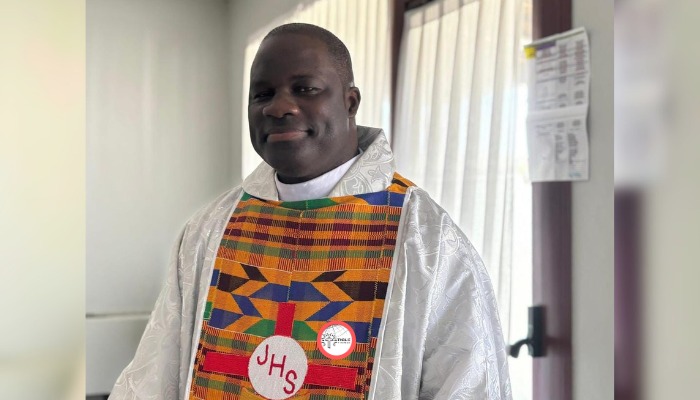
Rev. Fr. Albert Kyei Danso
Chaplain
Holy Family Ghanaian Catholic Community Church
Italy





Discussion about this post