


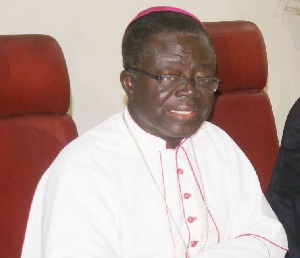
Question by Joseph Appiah Kubi (JoeKen), Hamburg, Germany:
Why do Catholic churches in Africa continue to display statues of Christ, Mary, and the saints with European features?
Answer by Most Rev. Joseph Osei-Bonsu:
Many Catholics across Africa ask why their churches still display statues of Christ, Mary, and the saints with European features. The answer lies mainly in history: in the customs the missionaries brought, in the cost and availability of religious goods, and in the affection communities have developed for images before which they have prayed for generations.
It does not lie in doctrine. The Church has never taught that Jesus, Mary, or the saints were European, and it does not require sacred images to bear European features. At the same time, its teaching on inculturation invites African communities to express the Gospel through their own artistic traditions, so that the faith may be truly at home on African soil.
- Historical Background
Catholicism spread across sub-Saharan Africa mainly in the nineteenth and twentieth centuries through European missionaries. Congregations from France, Italy, Belgium, Portugal, Spain, and Ireland founded missions, schools, and parishes, and they brought with them the devotional practices and objects they knew. Statues, crucifixes, rosaries, and holy cards were imported from European workshops. Because few workshops in Africa produced Catholic statues at the time, parishes relied heavily on these suppliers.
African Catholics therefore inherited a European artistic tradition. They received it as a consequence of who supplied the images, and not as a statement about race. That inheritance explains why so many churches still display European-looking statues: the statues belong to the missionary legacy and have been handed down through the generations.
- Why Statues Became Important
Catholic teaching regards sacred images as aids to devotion that direct the mind to the person represented. Replacing a statue is therefore a more serious matter than changing the furnishings of a room. A parish may be deeply attached to a statue given at its founding, or to one associated with a pilgrimage, a particular grace, or a local devotion, and removing it can feel like erasing part of the parish’s own history.
Many African Catholics learned to pray before particular images, such as Our Lady of Grace, the Sacred Heart of Jesus, or Saint Anthony of Padua, and over time those images became bound up with their sense of the sacred. The attachment has less to do with physical appearance than with the memories and spiritual experiences connected to the image.
The statue of Mary at the Shrine of Our Lady of Lourdes at Buoho, in the Catholic Diocese of Konongo-Mampong, illustrates this. It was dedicated in 1949 and has drawn pilgrims from across the Ashanti Region and the rest of the country for more than seventy-five years. The sanctuary was begun by the Confraternity of Rosary Pilgrims, following a decree of Bishop Hubert Paulissen, then Vicar Apostolic of Kumasi and later its first bishop. It took its inspiration from the Marian grotto at Egyam, near Takoradi, in what is now the Diocese of Sekondi-Takoradi.
A comparable example is the Grotto of Our Lady of Lourdes at Agbenoxoe, near Kpando in the Volta Region, within the Diocese of Ho. Bishop Anthony Konings, then Bishop of Keta, consecrated it in 1957, after a local priest and a group of Catholics returned from a pilgrimage to Lourdes in France and resolved to build something similar at home.
It remains the principal Marian shrine of the diocese, and several thousand pilgrims gather there each year for an overnight vigil on 8 December, the feast of the Immaculate Conception. Older parishioners have prayed before statues of this kind all their lives. They brought their children to be baptised in their presence and buried their dead in their presence. To replace such a statue can feel like erasing memory.
- Economics and Availability
Economic realities also play a part. Mass-produced statues from Europe or Asia are cheaper and more readily available than works commissioned from local artists, which take more time and money. Many statues were gifts from missionaries, partner parishes, or benefactors, and it was natural to use them. Their presence often reflects affordability and availability rather than preference. For parishes with limited resources, imported statues were a practical solution, even when they did not reflect African features.
- The Meaning of Colour
In Christian art, white commonly symbolises purity, holiness, and light, so a white-painted statue does not by itself imply a racial identity. The overall visual environment of a church nevertheless matters.
If nearly every sacred figure is shown with European features, while Africans appear only in ordinary or negative roles, the imagery can convey a troubling message about who may be holy and who belongs. Sacred art also teaches, especially children, who meet the Gospel through what they see before they can read Scripture. The concern, then, is less with any single statue than with the message of the whole church interior, which should show that holiness is open to every people.
- What the Church Teaches About the Appearance of Jesus
Catholic doctrine makes no claim that Jesus or Mary were European. Historically, Jesus was a Jewish man of the first century from the eastern Mediterranean, and Mary was a Jewish woman of the same time and place. The Bible gives no physical description of either. European-looking statues are therefore artistic interpretations, not historical portraits.
The Church distinguishes between the image and the person it represents. Adoration belongs to God alone, while images are honoured because of the one they portray. It follows that depicting Christ or the saints with African features is equally legitimate.
The Second Council of Nicaea, held in the year 787, defended the use of sacred images on this ground, teaching that the honour shown to an image passes to the person represented. Sacred art is symbolic; it is not photographic.
- The Question of Inculturation
Inculturation means that the Gospel takes root in each culture and is expressed through that culture’s legitimate forms. The Second Vatican Council and later teaching encouraged this adaptation while preserving the unity of the Church, and it applies to sacred art as much as to music and liturgy. African artists can create works that are fully Christian and rooted in African traditions.
The Nigerian artist Bruce Onobrakpeya’s Stations of the Cross for Saint Paul’s Church in Lagos, perhaps his best-known Catholic commission, shows how African creativity can enrich Catholic worship. Such work helps Catholicism to be seen as part of African life rather than as something foreign.
- African Saints and Christian Art
The African heritage of the Church includes Saint Augustine of Hippo, Saint Monica, Saint Cyprian of Carthage, Saints Perpetua and Felicity, Saint Josephine Bakhita, and Saint Charles Lwanga and his companions. More recently it includes the Ghanaian martyr Saint Matthew Ayariga, whom Pope Francis included in the Roman Martyrology in 2023 together with the twenty-one martyrs of Libya. Depicting these saints with African features shows that holiness transcends race and culture.
Genuine inculturation requires more than repainting European statues in darker colours. It calls for art that draws creatively on African traditions while remaining faithful to Christian theology, and that requires close collaboration among artists, clergy, and communities.
- Why Change Has Been Slow
Although inculturation has long been encouraged, European-style statues remain common, for several reasons. Replacing them costs money and requires agreement within the parish, and parishes often give priority to evangelisation, education, and buildings.
Devotional attachment also slows change, since parishioners are reluctant to part with statues tied to generations of prayer. Finally, good sacred art requires trained artists and theological understanding, and simply producing African-looking figures does not guarantee quality. Change will therefore be gradual and will depend on resources, training, and pastoral sensitivity.
- A Balanced Catholic Approach
The Church does not ask anyone to reject older European-style statues. Many have become part of a community’s devotional heritage and can continue to nourish faith. New churches and shrines, however, need not rely solely on imported imagery.
Commissioning African artists to create sacred works, and giving prominence to African saints, allows African Catholics to see their own culture reflected in the faith. This approach respects what has been received while making room for new expression.
- What the Church in Ghana Can Do
Ghana has rich artistic traditions that can serve sacred art. Parishes and dioceses can encourage local artists to produce crucifixes, statues, Stations of the Cross, and paintings that reflect Ghanaian culture. Diocesan authorities should guide such projects to ensure that they are theologically and liturgically appropriate. Missionary-era art need not be discarded. This approach also follows the Catholic tradition itself, which has always handed on the faith in forms that speak to each generation and culture.
Conclusion
European-looking statues are common in African Catholic churches because of missionary influence, historical inheritance, devotional continuity, cost, and availability. Doctrine has no part in it. Catholic teaching does not prescribe a single physical appearance for sacred images, and African Catholics are free to develop art that reflects their own cultures while remaining faithful to the faith.
The task is not to remove every European statue. Older images deserve respect for the devotion they have inspired, while new works can embody African artistic traditions. In this way African Catholicism can honour its inheritance and offer its own voice to the universal Church. The Gospel is meant for all peoples, and through African faces and forms of beauty it can take deeper root on the continent.
| For further explanations or enquiries, you may contact the author, Most Rev. Joseph Osei-Bonsu, Emeritus Catholic Bishop of Konongo-Mampong, on this number: 0244488904, or on WhatsApp (with the same number). |

![[Opinion] It’s time for the Catholic Church to “own” the Ghanaian state](https://catholic-trends.com/wp-content/uploads/2026/09/Screenshot-2026-09-21-124614.png)




Discussion about this post