


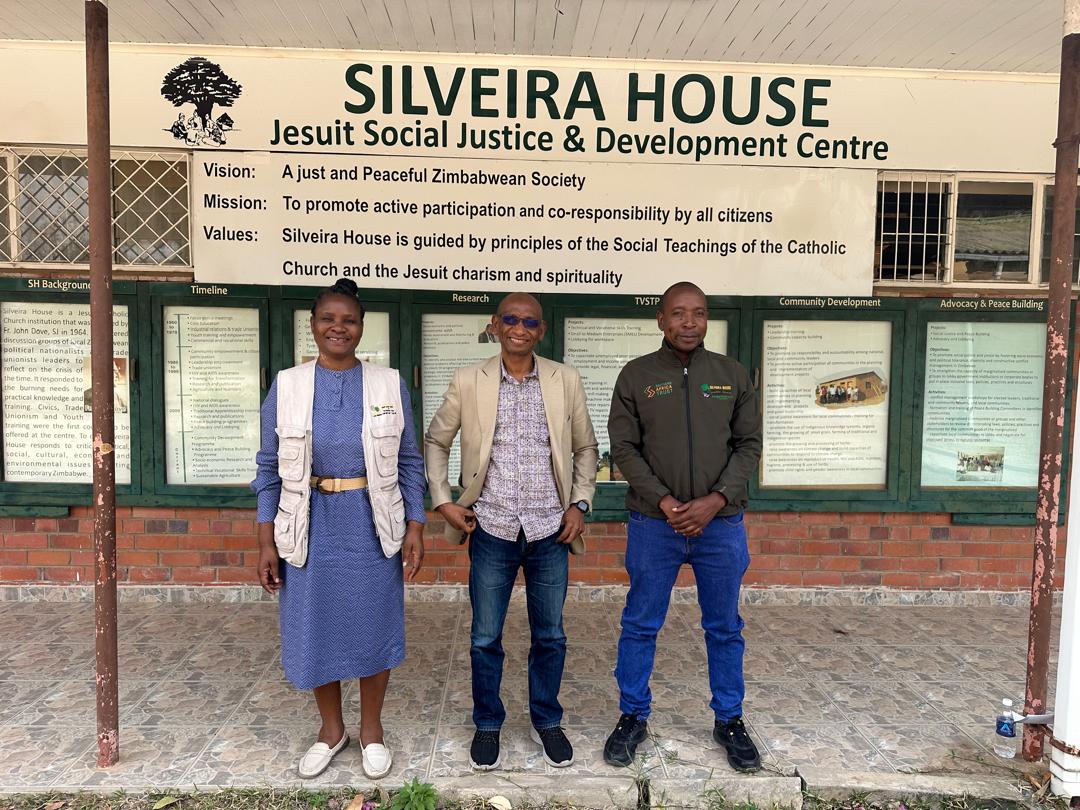
The Director of the Arrupe Jesuit Institute (AJI), Fr. Bernard Jado, SJ, has undertaken visits to Jesuit institutions in Zimbabwe and Zambia to learn from their experiences and explore opportunities for institutional collaboration.
The visits, which took place from September 18 to October 5, 2026, formed part of efforts to strengthen the Institute’s capacity through knowledge-sharing, networking and potential partnerships with established Jesuit social apostolates in the region.
In Zimbabwe, Fr. Jado visited Arrupe Jesuit University in Harare, where he spent two nights, before proceeding to Silveira House, a Jesuit social apostolate engaged in governance, justice, peacebuilding and climate change issues.
According to Fr. Jado, the visit to Silveira House provided an opportunity to understudy the institution’s longstanding work, particularly its engagement with government, policy advocacy and social development initiatives.
Having operated for nearly 60 years, Silveira House has accumulated considerable experience in working with government institutions and influencing public policy on various social issues.
During his week-long engagement, Fr. Jado interacted with the Director and programme staff, gaining insights into the institution’s programme implementation, achievements, challenges and funding arrangements.
One of the key lessons from the engagement was the need for Jesuit social apostolates to explore sustainable funding models amid growing donor fatigue and uncertainty surrounding external funding.
He observed that Silveira House was developing a strategic approach that would enable it to move beyond heavy reliance on donor support by designing projects capable of generating income to sustain its operations.
“The idea is to see how they can begin to come up with projects that can be successful and can earn some income,” he explained.
Fr. Jado said the experience offered valuable lessons for AJI as it continues to strengthen its programmes and institutional sustainability.
Beyond learning from Silveira House, the visit also provided an opportunity to establish professional contacts that could facilitate future collaboration, particularly in programme development and capacity building.
From Zimbabwe, Fr. Jado travelled to Lusaka, Zambia, on September 25, where he spent the remainder of his visit engaging with the Jesuit Centre for Theological Reflection (JCTR) another apostolate whose work places a strong emphasis on research and theological reflection.
The institution works closely with the Zambian government on policy and social issues, including climate change, unemployment and other development challenges.
During his stay, Fr. Jado participated in the institution’s regular Monday staff meetings, which provide a platform for departmental updates, coordination and planning of activities.
He described the experience as an opportunity to gain a better understanding of the institution’s organisational structure, operations and approach to addressing social concerns.
He also visited other Jesuit apostolates in Zambia, including an agricultural farm, which provided further exposure to the diverse nature of Jesuit mission and development initiatives in the country.
Reflecting on the two visits, Fr. Jado said the relationships established would provide a foundation for future engagement between AJI and the institutions.











Discussion about this post