


Question by Patrick Amoah Sarfo:
My Lord Bishop, I respectfully seek clarification on the Catholic Church’s teaching regarding the ownership and use of tithes and offertory envelopes. I have come across the understanding that these funds are sometimes considered as belonging to the priest. If this is the case, I kindly ask how such monies are to be used in practice.
Furthermore, I would be grateful for clarification on the rationale behind this understanding, especially in light of the Church’s provision for the priest’s upkeep, including fuel for vehicles, utilities, maintenance of the mission house, stipends, and related pastoral expenses.
In view of these clarifications, I humbly request your guidance to help me to understand better the correct practice and its theological basis.
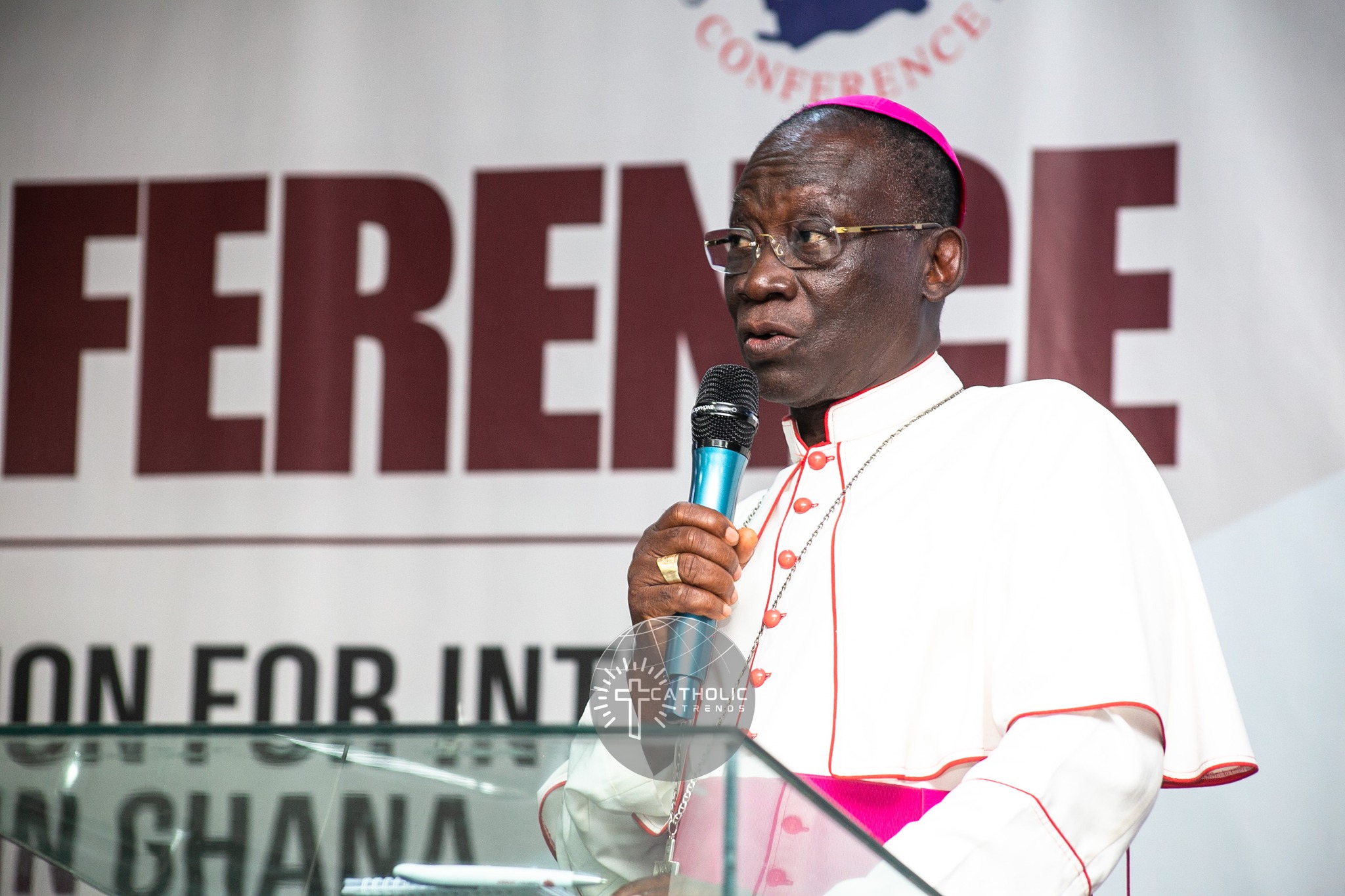
Answer by Most Rev. Joseph Osei-Bonsu:
Dear Patrick, the questions you raise touch on an important aspect of the Church’s life, namely the stewardship of material goods and the proper support of her ministers.
- Ownership and Use of Tithes and Offertory
First of all, it must be clearly stated that tithes, offertory collections, and monies given in envelopes do not constitute the personal property of the priest. Tithes, in the traditional Christian understanding, are offerings made by the faithful to God—historically amounting to one-tenth of one’s income or produce—as an expression of gratitude, worship, and support for the mission of the Church.
According to the mind of the Church, such contributions are ecclesial goods; that is, they are given to the Church for her mission, for divine worship, for works of charity, and for the proper sustenance of her ministers. The faithful therefore offer these gifts not to a priest as a private individual, but to the Church as the Body of Christ. The principal purpose of tithes and offertory donations is to sustain the life and work of the Church.
This includes the maintenance of parish structures, the celebration of the sacraments, the support of charitable initiatives, and the provision for pastoral ministry.
With regard to legal ownership, parish funds—including tithes and offerings given through envelopes—belong not to the priest but to the parish as a juridic person, established in law to carry out the Church’s mission. In accordance with the Code of Canon Law (Canon 1257), all temporal goods that belong to a parish are classified as ecclesiastical goods and are therefore governed by the norms of the Church. Such goods are not the personal property of the priest.
This distinction between ecclesiastical goods and a priest’s personal assets is essential, both in canon law and in pastoral practice. Although the priest serves as the administrator of the parish’s temporal goods, he does so in a fiduciary capacity—that is, he manages these goods not as an owner but as a steward entrusted with them on behalf of the Church.
He is therefore bound to act with honesty, accountability, and prudence, using the parish’s resources solely for their proper ecclesial purposes and in accordance with the norms of the Church.
There is a clear juridical boundary between what belongs to the parish as a corporate entity and what belongs to the priest as an individual. Consequently, offerings placed in envelopes by the faithful form part of the common resources of the parish and are not to be appropriated by the priest for personal use.
This directive is in keeping with the norms established by the Ghana Catholic Bishops’ Conference. Should members of the faithful wish to make personal monetary gifts to a priest, such gifts ought to be given outside the context of the Mass, for example before or after the liturgical celebration, so as to preserve the proper distinction between personal offerings and ecclesial funds.
In terms of administration, the governance of these goods is set forth in the norms of the Church, particularly those concerning temporal goods (cf. canons 1254-1310). Canon 532 states that the pastor represents the parish in juridical affairs and must administer goods according to Canons 1281–1288, ensuring their use for divine worship, clergy support, apostolic works, and charity.
The parish priest (pastor) is entrusted with the administration of parish goods, but he does so as a steward, not as an owner. He is bound to ensure that such funds are used for legitimate ecclesial purposes, including the maintenance of the parish, support of pastoral activities, charitable outreach, and the sustenance of clergy.
Furthermore, canon law (Can. 537) requires every parish to have a finance council. The parish priest and finance council together administer parish goods, with oversight from the bishop. This body ensures that offertory and tithe funds are used for parish operations, charitable works, and the maintenance of church property – not for the priest’s personal use. Priests must provide annual financial reports for transparency (Canon 1284).
The funds collected are typically allocated to cover various expenses, including: maintenance of the church and parish facilities; utilities and fuel costs associated with the mission house or parish vehicle; stipends for the priest and support staff; programmes for spiritual, educational, and social outreach; and charitable works. Some of this money supports the priest’s upkeep while some supports church maintenance and programmes, always with oversight from the required Parish Finance Council.
- Where Confusion May Arise: Stole Fees and Mass Stipends
The misconception that these funds ‘belong to the priest’ likely arises from confusion with Mass stipends (Canons 945-958), which are personal offerings for specific intentions, while general collections remain parish assets. It is true that in some local contexts or historical practices, certain offerings – especially Mass stipends – are assigned to the priest. Even here, the Church regulates their use carefully, and they are not to be confused with general offertory or tithes.
The priest may receive what is legitimately designated for him according to diocesan norms, but always within the framework of accountability and ecclesial discipline.
Specifically, certain distinctions must be made regarding different types of offerings. Mass offerings, also known as stipends, are given when a member of the faithful requests that a Mass be celebrated for a particular intention, such as for a deceased loved one; according to Canon 945, such a stipend is traditionally due to the celebrating priest personally. Stole fees, on the other hand, are voluntary offerings made on the occasion of sacraments such as baptisms, weddings, or funerals; their disposition depends on the directives of the diocesan bishop, and they may either be retained by the priest or shared with the parish.
Personal gifts must also be distinguished: when an envelope or offering is clearly designated as a personal gift to the priest, for example marked “for Father’s personal use,” it belongs to him as an individual. By contrast, offerings collected during the ordinary parish offertory are ecclesial funds, and the priest does not have personal ownership of them.
- Provision for the Priest’s Upkeep
With regard to the priest’s sustenance, the Church teaches that clerics deserve just remuneration (cf. canon 281 §1), sufficient for their needs and appropriate to their condition, so that they can live with dignity and fulfil their ministry effectively.
This support may come through structured means established by the diocese, such as stipends, allowances, or common funds. In many places, provisions are indeed made for housing, utilities, transportation, and healthcare, precisely to ensure that priests are not personally dependent on irregular or unclear sources of income. Because these needs are met by the parish or diocese, any surplus from the offertory remains in parish accounts for future projects, repairs, or assistance to the poor. The priest receives a stipend, housing, and expenses, but he does not ‘own’ the collection.
- The Theological Basis
Theologically, this arrangement reflects a deeper truth: the priest does not work for himself, but for Christ and his Church. Therefore, what is given by the faithful is offered to God, and the priest, as minister, participates in its administration with a sense of responsibility, transparency, and detachment. He is called to a life of simplicity and integrity, avoiding even the appearance of personal appropriation of Church goods.
The rationale for this practice is best understood within the broader context of stewardship and the communal nature of the Church.
First, there is the principle of stewardship: the faithful are called to be responsible stewards of the resources entrusted to them, and their contributions to the Church are an expression of faith and a concrete support for her mission and common life. Within this framework, the priest is not the owner of ecclesiastical goods but their servant, entrusted with administering them faithfully for the purposes for which they are given.
Secondly, there is the dimension of community support. The shared character of these funds reflects the Church’s identity as the Body of Christ, in which all members are bound together in mutual responsibility. The faithful offer their gifts to God through the Church, and the Church, in justice, provides for those who dedicate themselves to ministry. In this way, giving and receiving are integrated into the life of the ecclesial community.
Finally, provision for the priest must be understood within this same communion. The parish community supports its priest both spiritually and materially, recognising the central role he plays in pastoral care and in the celebration of the sacraments. This mutual relationship highlights the interdependence that exists within the Church, where each member contributes to the good of all and shares in the responsibility for sustaining the life and mission of the community.
The obligation of the faithful to support the needs of the Church is grounded in both Scripture and canon law. Canon 222 of the Code of Canon Law teaches that the faithful are bound to assist the Church so that she may have what is necessary for divine worship, the works of the apostolate and charity, and the proper sustenance of her ministers; this duty is likewise affirmed in the Catechism of the Catholic Church (no. 2043).
This responsibility arises from the principle of stewardship, by which all that one possesses is recognised as a gift from God to be used for his service. In the Old Testament, this was expressed in practices such as tithing, whereby a portion of one’s produce or income was dedicated to the Lord for the support of the Levites and the needy, as seen in Leviticus 27:30 and Deuteronomy 14:28.
In the New Testament, this principle is reaffirmed in the teaching of Saint Paul, who states in 1 Corinthians 9:14 that “the Lord commanded that those who proclaim the Gospel should get their living by the Gospel,” thereby ensuring that ministers are able to devote themselves fully to their mission without undue material concern. In continuity with these scriptural foundations, Canon 1254 specifies that the temporal goods given by the faithful are to be used for clearly defined purposes: the ordering of divine worship, the just and dignified support of the clergy, and the promotion of works of the apostolate, including charity and mission.
- Summary of Fund Types
In summary of the different types of funds and their ownership, the following distinctions apply. Sunday offertory collections and tithes are legally owned by the parish as a juridic person, and their typical use is for parish operations, maintenance, charity, and diocesan assessments.
Mass stipends, by contrast, are personally owned by the celebrating priest, though they are often donated, and their typical use is for the priest’s personal support. Stole fees received on occasions such as baptisms, weddings, and funerals are owned according to the local bishop’s directive, meaning they may be the priest’s personal income or shared with the parish. Finally, personal gifts explicitly marked for the priest are owned by the priest as a natural person and are for his personal use.
- 6. Summary and Conclusion
In summary, therefore, tithes and offertory collections are ecclesiastical goods and belong to the Church rather than to the individual priest. The priest’s role in relation to these resources is that of a steward, exercising administration under the authority and norms of the Church.
The Church, in turn, is responsible for ensuring the just and regulated provision of the priest’s material needs. Consequently, any personal benefit received by a priest must always be consistent with the provisions of canon law and the applicable directives of the diocese or episcopal conference.
| For further explanations or enquiries, you may contact the author, Most Rev. Joseph Osei-Bonsu, Emeritus Catholic Bishop of Konongo-Mampong, on this number: 0244488904, or on WhatsApp (with the same number). |








Discussion about this post