


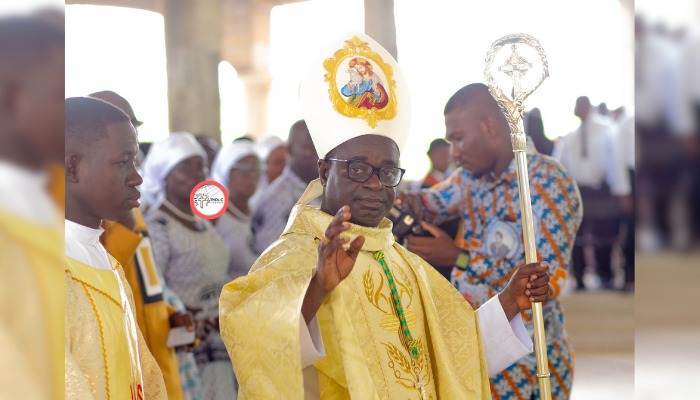
The Catholic Bishop of Ho, Most Rev. Emmanuel Kofi Fianu, SVD, has lifted the remaining COVID-19-related restrictions that have been observed during liturgical celebrations in the Ho Diocese.
The decision, contained in a circular dated Monday, August 17, 2026, follows the absence of any new health advisories requiring continued restrictions during public worship.
The circular, addressed to all clergy, consecrated persons and lay faithful of the Diocese, noted that following the outbreak of COVID-19, the Ghana Catholic Bishops’ Conference issued guidelines introducing several restrictions for public worship.
According to Bishop Fianu, a number of those restrictions had been gradually lifted since 2024, while some remained in force as precautionary measures to help curb the spread of the virus and other infections.
“Since 2024, a number of these restrictions have been lifted but a few remained in force as precautionary measures to curtail the spread of the virus and some other infections,” he stated.
He said that, in the absence of new cautions from the health authorities, it was appropriate to lift the remaining restrictions.
The Bishop therefore announced that the following practices are no longer restricted during liturgical celebrations in the Diocese:
1. Holy water at church entrances: Parishes may continue to place holy water in receptacles at the entrances of churches for the faithful to sign themselves with the Sign of the Cross.
2. Sign of peace: The faithful may shake hands during the Sign of Peace. However, worshippers are encouraged to avoid moving around the church to greet people, as it is sufficient to exchange the gesture with those nearby.
3. Reception of Holy Communion on the tongue: The faithful may receive Holy Communion on the tongue. However, priests are urged to exercise caution and avoid touching the tongue of communicants while distributing Holy Communion. The faithful are encouraged to receive Holy Communion in the hand.
4. Use of chalices: The Diocese continues to recommend that extra chalices be provided where concelebrating priests are present. The main chalice should be used only by the principal celebrant, who should ensure that it is properly purified after use.
5. Entrance procession: All concelebrating priests may join the entrance procession. However, priests who arrive after the entrance procession are not permitted to concelebrate the Mass.
Despite the lifting of the restrictions, Bishop Fianu urged priests and the faithful to remain vigilant and continue to observe appropriate health precautions.
He encouraged them to use hand sanitisers whenever they considered it necessary, stressing the importance of prioritising personal and communal health.
“We should all put our health first,” the Bishop said.
The directive takes effect immediately and applies to liturgical celebrations throughout the Catholic Diocese of Ho.
![[Opinion] Catholic youth on mission – YES: from Sunyani to the world](https://catholic-trends.com/wp-content/uploads/2026/08/WhatsApp-Image-2026-08-22-at-13.14.17.jpeg)





Discussion about this post