


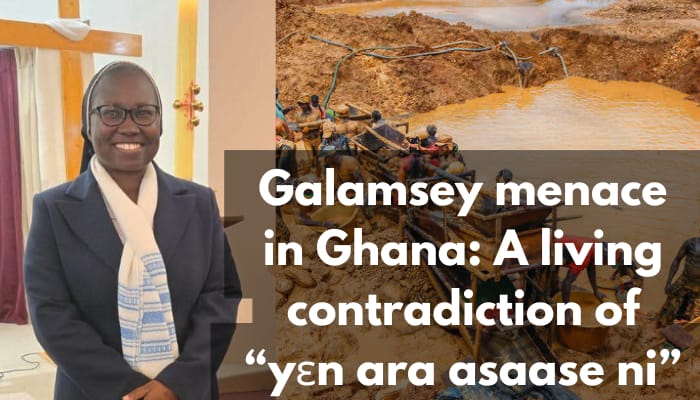
These days, when the whole world is watching the battle over resources, the economy and autonomy in Venezuela, Greenland and Congo, it is worth sparing a thought for how these issues are also playing out in Ghana. Step back, pause and reflect.
This is what I have been telling myself in the past few weeks. The continuous practice of this and critically reflecting on a number of things, has led me to a profound realisation about Ghana’s land, its heritage and the persistent devastation from illegal gold mining popularly known as galamsey.
This activity, while bringing short-term livelihood profit, is tearing apart the very fabric of our national identity symbolised in Ghana’s unofficial national anthem ‘Yɛn Ara Asaase Ni’. The more I reflect on the anthem’s message, the more I can’t help but question: Why did Ephraim Amu, write this song? What kind of background influenced the content of the song? What values did it aim to uphold? And why are we struggling as a country to embrace the message in the song today? Are we failing to protect our environment in a way that respects our history and preserves our future?.
Yɛn Ara Asaase Ni: A Song of Pride and Responsibility
When Ghana attained independence; national symbols, among other things that reflected the collective consciousness of our unique identity, became crucial. One of them was the national anthem. “Yɛn Ara Asaase Ni”, composed by Ephraim Amu is one of the anthems shortlisted to replace the colonial anthem, God Save the Queen.
The title of the anthem literally means This is Our Own Native Land. It evokes a deep sense of patriotism and communal responsibility, a call for each generation to arise with the determination to build upon and enhance the achievements of those who came before them. The stanzas call on all Ghanaians to uphold the welfare of others and to see peace and prosperity as values rooted in good character, respect, selflessness and care for the common good. Part of the first verse reads:
‘This is our own native land;
What a priceless heritage,
Acquired with the blood
our ancestors shed for us;
It is now our turn
to continue what our ancestors started’
Growing up, this song was ingrained in our daily lives. It was played by the Ghana Broadcasting Corporation (GBC), especially over the radio at specific times of the day. It was heard everywhere in the country even though it was not the official anthem. It was heard at public gatherings and live performances, and its message of national consciousness always triggers a stiff body that connotes attentiveness to the wording and respect for what we stand for as a nation.
At school, I sang it at morning assembly. Love for our land, appreciation and respect for our ancestors’ sacrifices and a responsibility to develop, protect and preserve our heritage was instilled in us through this song. In reflecting on this I am reminded of Paulo Freire, who argues that those who recognise themselves as oppressed must take part in creating their own liberation. Amu’s song in this sense, functions as a pedagogical tool calling each generation to reflect on the achievement of the past, critically assess present realities and take action that fosters development and protects inherited heritage.
As Freire notes, “no pedagogy which is truly liberating can remain distant from the oppressed” (2005:54). Today as we grapple with the environmental impact of galamsey, the anthem reminds us of our duty to safeguard our homeland.
Galamsey: The Price of Gold at the Cost of our Land
Galamsey is a popular Ghanaian local parlance coined from two words ‘gather and sell’. It suggests easy and free access to gold in the country. Ghana’s rich history with gold dates back over a millennium and once earned it the title of Gold Coast. Before independence, the Portuguese, one of Ghana’s colonisers, called it ‘Mina’, meaning a gold mine. For over a thousand years Ghana has produced a substantial portion of the world’s gold. The popular economic related activity in Ghana today is galamsey.
It refers to small-scale mining that involve both sophisticated and artisanal machineries and tools depending on who the operators are. The activity has been legally permitted since 1989. However, research suggests that many people operate illegally. The large unregulated and often illicit operations are costing us dearly. As if we are not accountable to anyone and even our very selves, precious vast lands in the forest belt are destroyed by seekers of gold.
River systems are being destroyed replacing clean, life-sustaining water with murky streams devoid of life and chemically polluted water. Two pictures of the River Pra in the Central Region of Ghana still remain vivid in my mind: one of clear water teeming with life and the other of muddy, lifeless water. This stark contrast stands as a testament to the destructive impact of galamsey.
The health implications of the activity is enormous. People are exposed to chemicals such as mercury and cyanide which are used to extract the gold. Communities depending on the nearby rivers in galamsey communities stand the risk of water borne diseases and other health related conditions, posing a huge challenge to public health.
The influx of foreign, particularly Chinese investors, into Ghana’s illegal mining is causing many young boys in small-scale mining areas to abandon education for quick profits. Galamsey is further jeopardizing agriculture which used to be the bedrock of Ghana’s economy by displacing farmers and destroying fertile farm lands. With the large involvement of Ghanaians in the galamsey operation, I tend to describe it as tragedy that is imposed by our own hands. It is a modern exploitation echoing the injustice of the past. Have we forgotten that this land is ours to protect? Are we so driven by profit that we are willing to sacrifice our natural heritage? Where is Ghana, the “Warrior King” reflected in the meaning of its name, the one who victoriously fights that which seeks to destroy it.
We Are All Accountable
Amu’s unofficial national anthem, ‘This is our own Native Land’ conveys a sense of ownership of a cherished heritage. This profound sense of heritage and belonging also implies the desire to preserve and protect what we have inherited and improve upon it. It is a call to responsibility.
It demands a collective action because proper accountability lies in the state in which we hand over the land to another generation. We are all accountable in this regard. Given the impact of Galamsey, it is crucial for the government, policymakers, chiefs (as custodians of land), small-scale miners, organisations, institutions, and individuals to recognise the harm caused and prioritise the common good over personal or group interests.
Wolfgang Sachs and other critical development theorists highlight that to conceive an escape from destructive conditions, we must first accept the existential danger in which we find ourselves. While the continued campaign against Galamsey by different organisations, groups, and institutions serves as an awareness of a reality we do not want to maintain, the current environmental degradation is a stark reminder of how far we still have to go.
In my view, Amu’s unofficial national anthem carries a message to uphold national pride and responsibility. It speaks to a collective duty. Our continued fight against Galamsey is not merely an environmental or economic struggle. It is a call to action, a demand that we all rise together to defend our environment, our heritage and our future. Perhaps it is time we all pause to consider, in Ghana, Congo, Venezuela, Greenland and beyond, how struggles over resources shape our politics, our livelihoods, and the future of our planet.








Discussion about this post